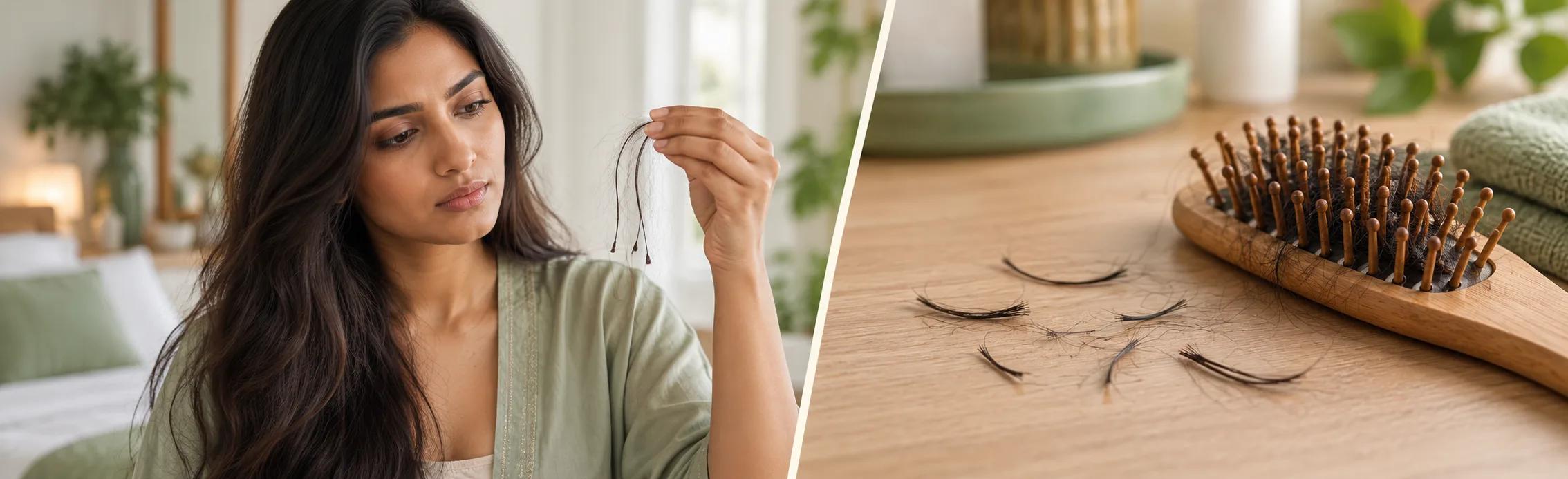
Hair Fall After Weight Loss: Why It Happens and When It Stops
The scale finally moved and now your hair is falling out. Here is why hair fall after weight loss happens, how long it lasts and what actually helps it grow back.

In this article(13 sections)
- Why your hair falls out after losing weight
- Is it the weight loss or the way you lost it?
- How to tell if it is this or something else
- What actually helps the hair come back
- Eat enough protein every day
- Stop the crash and eat like you plan to live
- Get your iron checked
- Be gentle with the hair you have
- Give it time
- What does not help
- When to see a doctor
- The part nobody tells you
- Sources
You did it. Months of early walks, smaller plates and saying no to the second helping at every family function. The scale finally shows the number you wanted and your old jeans fit again. Then one morning you look down in the shower and there is a clump of hair near the drain. The next day there is more on your pillow. Your comb looks like it belongs to someone else. It feels unfair. You worked this hard to feel better about yourself and now you are scared of losing your hair. Take a breath. Hair fall after weight loss is very common. It usually has a clear reason. And in most people, it stops on its own and the hair grows back. Here is what is going on and what you can do about it.
Why your hair falls out after losing weight
Every hair on your head is on its own little clock. Most of them are growing at any given time. A small number are resting. After a few months of rest those hairs fall out and new ones start in their place. That is why losing 50 to 100 hairs a day is normal and you never notice it. A big change like losing a lot of weight quickly tells your body to save energy. Hair is not essential for survival, so your body moves a large number of growing hairs into the resting stage all at once. Nothing looks different at first. The hairs stay put for about two to three months. Then they all let go around the same time. Doctors call this telogen effluvium. The American Academy of Dermatology lists losing 20 pounds or more (about 9 kilos) among the common triggers, along with childbirth, high fever and major stress. This delay is why it catches people off guard. By the time the hair starts falling you have usually finished the diet and started eating normally again. It feels like it came from nowhere. It did not. Your hair is simply reacting to something that happened months ago.
Is it the weight loss or the way you lost it?
Losing weight slowly and steadily rarely causes noticeable shedding. The trouble usually starts with the fast methods.
Crash diets: where you eat very little for weeks
Cutting out whole food groups: Such as dal, eggs, paneer and dairy all at once
Skipping meals: To make the number drop faster before a wedding or a trip
Weight loss surgery: Where a large review found that about 57% of patients noticed hair loss afterwards
In all of these the body suddenly gets far less of what hair is made from. Protein is the big one because hair itself is protein. Iron and zinc matter too. A review on diet and hair loss points to low protein, low iron and low zinc as the common nutritional links to shedding. Iron deserves a special mention for women. Heavy periods plus a diet with fewer calories can drain your iron stores without you realising. Low stored iron has been studied as a possible factor in hair loss in women. We wrote more about the signs in our guide to iron deficiency in women.
How to tell if it is this or something else
Weight loss shedding has a pattern. Check whether this sounds like you.
It started roughly two to four months after you began losing weight
The hair is coming out from all over the head and not in one patch
Many fallen hairs have a tiny white bulb at the root
Your scalp looks normal with no redness, itching or scaling
If that matches, you are most likely looking at shedding and not true balding. The follicles are still alive. They are just between hairs. Hair that snaps halfway down the length is a different problem. That is breakage and it has different causes. This guide on hair shedding vs hair breakage shows you how to tell them apart in a minute.
What actually helps the hair come back
There is no overnight fix here. What you are really doing is giving your body enough to rebuild while you wait for the old hairs to cycle out. These are the things worth your effort.
Eat enough protein every day
This is the most important step and the one most people get wrong while dieting. India's nutrition body ICMR-NIN suggests roughly 0.8 grams of protein per kilo of body weight a day for adults. For someone who weighs 60 kilos that is around 48 grams.
In everyday food that could look like a bowl of dal at lunch, two eggs or a cup of curd in the morning, a piece of paneer or chicken at dinner and a handful of roasted chana as a snack. You do not need protein powder unless you cannot get there with food.
Stop the crash and eat like you plan to live
If you are still losing weight, slow it down. Aim for a small steady loss each week instead of a big drop. Your hair responds to how your body is fed across months not days.
Get your iron checked
A simple blood test for haemoglobin and ferritin tells you whether your iron stores are low. It is cheap and most labs in India offer it. Do not start iron tablets on a guess. Too much iron is also harmful. Take them only if a test shows you need them and your doctor agrees.
Be gentle with the hair you have
Tight ponytails, hot styling and rough towel drying do not cause this kind of shedding. They can still add breakage on top of it and make things look worse. Loose styles and a wide tooth comb help for now. Our list of ways to prevent hair breakage has more simple habits.
Give it time
This is the hard part. Once the trigger is gone the shedding usually slows over the next few months. Regrowth comes after that. Most people see their hair looking fuller again within six months to a year. The first sign is often short new hairs standing up along your hairline and parting. Those baby hairs mean it is working.
What does not help
**Extra biotin.** Biotin is in almost every hair supplement including our own Aora Chamrose. The review on diet and hair loss found little evidence that biotin helps people who are not low in it and true biotin deficiency is rare. Biotin also interferes with some blood tests including thyroid tests. If you take any product with biotin, tell your doctor and the lab before a blood test and ask if you should pause it for a few days.
**Piling on vitamins.** More is not better. Too much vitamin A or selenium can itself cause hair loss.
**Oils and treatments that promise to stop fall in a week.** Oiling can make your hair feel softer. It cannot change the hair cycle your body has already set in motion.
If your diet has been limited for a long time a daily multivitamin such as Aora Nutrivit Plus can help cover small gaps while you get your meals back on track. It supports your food. It does not replace it. Our article on whether hair growth supplements actually work goes into this honestly.
When to see a doctor
Most weight loss shedding settles without treatment. See a doctor or a dermatologist if any of these apply to you.
The shedding is still heavy after six months
You see bald patches, a widening parting or a receding hairline
Your scalp is itchy, painful, flaky or red
You also have tiredness, feeling cold, weight changes you cannot explain or irregular periods
Those can point to other causes such as thyroid problems, PCOS or pattern hair loss. They are all treatable and they are easier to treat when caught early. Our guide to hair loss in women covers the other common reasons.
The part nobody tells you
The hair falling out now is not a sign that something is going wrong today. It is a delayed echo of the stress your body went through months ago. By the time you see it the worst is usually already over.
So keep eating well. Keep your protein up. Get the blood test if you have not. Then be patient with yourself. You changed your body once. Your hair just needs a little longer to catch up.
Sources
*This article is for general information and is not a substitute for advice from your doctor. Speak to a qualified healthcare professional before starting any supplement, especially if you are pregnant, breastfeeding or taking medication.*
Continue this topic
Connected guides, ingredient explainers, product context, and tools chosen from this article's topic cluster.
Fatigue, B12, vitamin D, iron, zinc, daily multivitamins
Relevant for daily micronutrient support.
Recovery problems are not always solved by another supplement. Sometimes the real issue is sleep, training load, food or simply not enough time between hard sessions.
Hair on your pillow, brush or bathroom floor does not always mean the same thing. Learn the signs that can help you tell increased shedding from hair breakage.
Hair growth supplements are most useful when a genuine nutritional gap is contributing to hair loss. Learn what the evidence says about biotin, iron, zinc and other nutrients.
Quick questions
Does hair grow back after weight loss?
In most people it does. Shedding after weight loss happens because many hairs switch to their resting stage at the same time. The roots stay alive. Once your body is well fed again the shedding slows and new hair starts growing. Most people notice fuller hair within six months to a year.
How long does hair fall after weight loss last?
The heavy shedding usually lasts a few months. It often starts two to three months after the weight loss began and eases as your eating settles. If it is still heavy after six months it is worth seeing a doctor to check for other causes.
Can losing weight too fast cause hair loss?
Yes. Crash diets, skipping meals and cutting out protein rich foods are the most common triggers. Slow and steady weight loss with enough protein is much less likely to cause noticeable shedding.
Should I take biotin for hair fall after weight loss?
Biotin is unlikely to help unless you are actually low in it, which is rare. Eating enough protein and checking your iron levels matter more. Biotin can also affect some blood test results, so tell your doctor and the lab if you take it.
Which test should I get for hair fall after weight loss?
A blood test for haemoglobin and ferritin shows whether your iron stores are low. Your doctor may also check thyroid levels and vitamin D if you have other symptoms such as tiredness or irregular periods.
5 linked sources checked against our citation and claim-safety process.
Reviewed 29 Sept 2026 for supplement-claim and medical-disclaimer boundaries.
Recommended from the Aora range
Chamrose | Hair Fall Control, Thickness & Strength Support
Chamomile, Rosemary & Jatamansi Extract
- Hair Care
- Hair Support
- Made in India
From₹960.00
Try Aora - free
Put this article to work on you.
Health and safety notice
- This article is educational. It is not medical advice and is not a substitute for guidance from a qualified healthcare provider. Consult a physician before starting any supplement, especially during pregnancy or breastfeeding, with a medical condition, or while on medication.
- FSSAI compliance: Health supplements and nutraceuticals are not intended for medicinal use. Any supplement-related information is provided to describe nutritional or physiological support and should not be interpreted as a claim to diagnose, treat, cure, or prevent any disease. FSSAI regulates health supplements and nutraceuticals separately from medicinal products.
Read our full medical disclaimer and editorial policy.
Sources and editorial standards
- 1losing 20 pounds or more
- 2about 57% of patients noticed hair loss
- 3diet and hair loss
- 4studied as a possible factor in hair loss
- 5interferes with some blood tests
Supplement content is educational only and should not replace medical advice from a qualified clinician. Product mentions are reviewed for claim safety before publication.