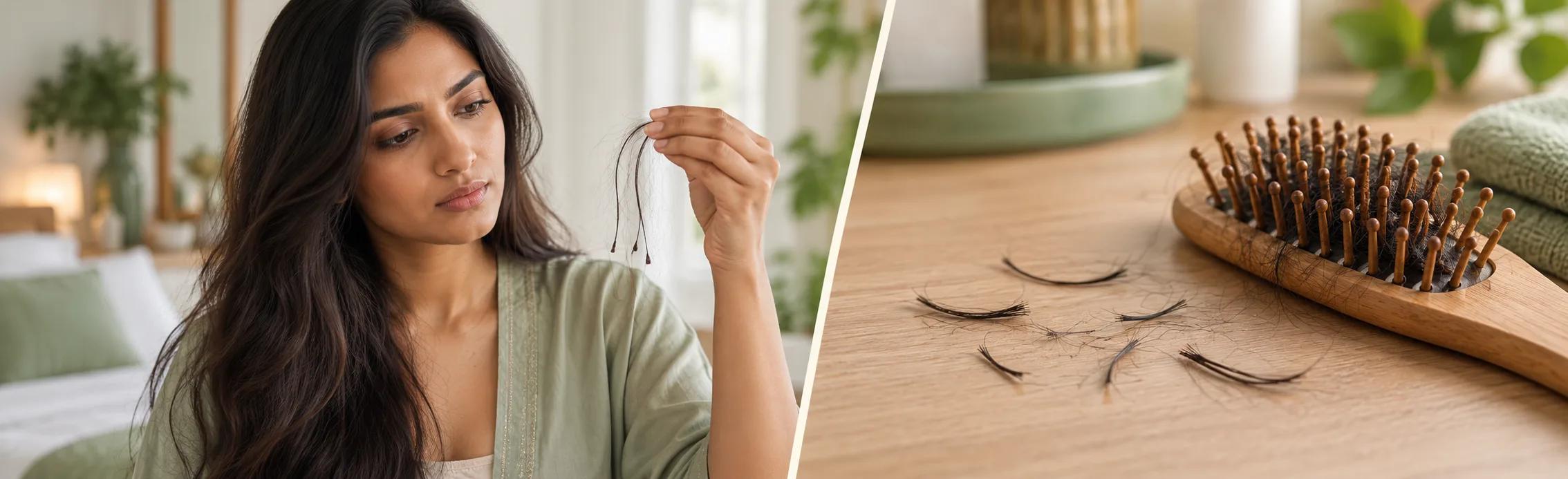
Hair Fall After Fever or Dengue: Timeline and What Helps
Handfuls of hair in the shower months after dengue or a viral fever? Why it happens, how long it lasts and what actually helps it grow back.

In this article(12 sections)
- Why does a fever make your hair fall out months later?
- Is hair fall after dengue or COVID common?
- A rough timeline for hair fall after fever
- Signs your hair is recovering
- What actually helps your hair recover
- Eat enough protein and enough food overall
- Check iron and other levels if your doctor advises
- Be gentle with the hair you have
- What does not help
- When to see a dermatologist
- Waiting it out without losing heart
- Sources
You have recovered from dengue or a bad viral fever, your blood tests are back to normal, and life has returned to its usual routine. Then, a few weeks later, you notice something worrying. There's more hair than usual in the shower drain, your comb fills up faster, and every time you run your fingers through your hair, a few more strands come away. Could your recent illness be the reason? Hair fall after fever is fairly common, especially after illnesses like dengue, typhoid or COVID-19. It usually begins two to three months after the illness, when more hair than usual enters the shedding phase. Doctors call this telogen effluvium, and in most cases, it's temporary. According to the American Academy of Dermatology, hair often regains its normal fullness within six to nine months as the body recovers. But what causes this delayed shedding, and is there anything you can do to help? Here's what to expect during recovery, which treatments may help and when it's worth seeing a dermatologist.
Why does a fever make your hair fall out months later?

Each hair on your head goes through a cycle. It grows for years, then rests for a few months, then falls out so a new hair can grow through from the same root. On a normal day, most of your hair is in the growing phase. The American Academy of Dermatology says it is normal to shed 50 to 100 hairs a day. A high fever or a severe infection is a big shock to the body. In response, a large number of hairs switch from growing to resting all at the same time. Nothing visible happens then. The resting phase lasts a few months, so the fall arrives long after you have recovered. Doctors call this telogen effluvium. Telogen is the resting phase. Effluvium simply means shedding. The StatPearls review on telogen effluvium lists acute febrile illness and severe infection among the common triggers, next to surgery, childbirth, crash dieting and low protein intake. The same process can follow rapid weight loss.
Also read: Hair fall after weight loss: Why It Happens and What Can Help.
Is hair fall after dengue or COVID common?
Hair fall after these infections has been reported in several studies.
After COVID, a Turkish study of 204 people found that 27.9% developed hair shedding linked to the infection, on average about 54 days after testing positive. It was much more common in women than in men.
After dengue, a study from Vietnam that followed mostly children found that hair loss was one of the symptoms that often persisted at three months, even when most other after-effects had settled.
A survey of adults after a dengue outbreak in Madeira, Portugal, found that abundant hair loss was among the most frequent symptoms reported later. This was based on people recalling their symptoms years afterwards, so it is weaker evidence.
There are fewer studies on typhoid or ordinary viral fever. The mechanism is the same, though. Any illness with high fever, poor appetite and days in bed can tip a large batch of hairs into rest. In India, dengue and other fevers rise with the monsoon, so a wave of worried shedding can follow a few months later.
A rough timeline for hair fall after fever
Every person is different, but the published markers give a rough shape.
During the illness and the first weeks of recovery, your hair looks normal.
A few months after the illness, the AAD says, is when most people notice the extra shedding. In the Turkish COVID study it began about 54 days after a positive test, on average. You notice it on the pillow, in the shower and on the comb.
Within six to nine months, the AAD says, the hair tends to regain its normal fullness as the body readjusts.
The AAD notes that if the stress continues, the shedding can go on longer. A second illness, ongoing poor eating or a difficult few months at home can stretch the timeline.
Signs your hair is recovering
These are the signals that the worst is behind you.
Fewer hairs in the shower or on the comb compared with a month ago.
Short, fine hairs standing up along your hairline and parting. They look like baby hair and are easy to miss.
The fallen hairs have a small white bulb at the root. That bulb is typical of a resting hair that has finished its cycle.
No bald patches. The thinning is spread over the whole scalp.
If you are not sure whether you are losing hairs from the root or snapping them halfway, our guide to hair shedding vs hair breakage shows how to tell the difference.
What actually helps your hair recover

After a fever or serious illness, your body needs time to recover, and so does your hair. There's no quick fix to stop the shedding overnight, but getting enough nutrition, rest and taking care of your overall health can support healthy hair growth as your body recovers. Here are some thing that can help:
Eat enough protein and enough food overall
After dengue or typhoid, appetite can stay poor for weeks. Many people live on khichdi, toast and coconut water long after the fever has gone. That is fine for the first few days. After that, your body needs real meals again to rebuild.
Add a protein food to every meal: dal, chana, rajma, paneer, curd, eggs, fish or chicken.
Do not skip breakfast. Idli with sambar, besan chilla, poha with peanuts or eggs with roti are easy starts.
If big meals feel heavy, eat smaller portions more often.
Do not start a weight loss diet while your hair is shedding. A calorie gap on top of an illness can put more hairs into rest.
This article on whether hair growth supplements work covers what nutrients do for hair.
Check iron and other levels if your doctor advises
Low iron is a common problem in India, especially in women. The Cleveland Clinic review on iron and hair loss describes checking iron stores in people with hair loss as the authors' own clinic practice. Ferritin, which shows how much iron your body has stored, can also be higher than usual during an infection or inflammation. So, if you get tested too soon after recovering from a fever, your ferritin level may appear normal even when your iron stores are low. Ask your doctor when it's best to get tested. Your doctor can recommend the right blood tests based on your symptoms. If you have heavy periods or still feel unusually tired after recovering, iron deficiency may be worth checking.
Also read: Iron deficiency in women: Symptoms, Causes and What to Check.
Avoid taking iron supplements without confirming that you need them, as too much iron can be harmful.
Be gentle with the hair you have
Use a wide-tooth comb. Do not tie a tight bun or ponytail every day. Skip new colouring, smoothening or rebonding for a few months. These do not cause telogen effluvium, but they can snap hair that is already thinning. A regular mild shampoo is fine. The hairs you see after a wash were already loose and would have fallen anyway.
What does not help
When you're losing more hair than usual, it's natural to want to try anything that might help. But not every popular hair remedy can stop the shedding.
Expensive hair oils: Oiling and a gentle scalp massage may feel relaxing and help reduce dryness or breakage. But once hair has entered the shedding phase, oil cannot prevent it from falling out.
Washing your hair less often: Skipping washes won't stop hair fall. The loose strands simply build up, so you may notice more hair coming out when you finally wash it. You can continue washing your hair as usual, using a gentle shampoo.
When to see a dermatologist
Most post-fever hair fall settles on its own. If you are concerned by the amount of hair falling out, the AAD says you can turn to a dermatologist, who can tell whether you have hair loss, excessive shedding or both. See a dermatologist or go back to your doctor if you are worried, if the shedding has not eased within the six to nine months the AAD describes or if you feel unwell in other ways. A dermatologist can examine your scalp and tell whether this is telogen effluvium alone. Sometimes a fever simply reveals a slower problem that was already there, such as pattern hair loss. For women, our guide on hair loss in women explains the other causes they will check.
Waiting it out without losing heart
The hardest part of hair fall after fever is the waiting. You did everything right. You got through the illness. Now your hair is falling and nothing seems to work fast. It may help to see the shedding for what it is: a delayed echo of how sick you were, not a sign that something new is wrong. Eat proper meals again, get the tests your doctor suggests and leave the hair alone as much as you can. In a few months, when you notice those short baby hairs along your parting in the bathroom mirror, you will know your body has caught up.
Sources
Hair shedding or hair loss (American Academy of Dermatology)
COVID-19 induced telogen effluvium (Dermatologic Therapy, 2021)
Burden of postinfectious symptoms after acute dengue, Vietnam (Emerging Infectious Diseases, 2023)
Medical Disclaimer: This article is for general information and is not a substitute for advice from your doctor. Speak to a qualified healthcare professional before starting any supplement, especially if you are pregnant, breastfeeding or taking medication.
Continue this topic
Connected guides, ingredient explainers, product context, and tools chosen from this article's topic cluster.
Sleep quality, magnesium, stress, recovery, evening routines
Relevant for daily micronutrient coverage alongside sleep and stress routines.
The scale finally moved and now your hair is falling out. Here is why hair fall after weight loss happens, how long it lasts and what actually helps it grow back.
Waking once or twice during the night is not always a problem. But if you are regularly wide awake at 2 or 3 AM, the pattern may offer clues about what is disturbing your sleep.
Hair on your pillow, brush or bathroom floor does not always mean the same thing. Learn the signs that can help you tell increased shedding from hair breakage.
Quick questions
How long does hair fall last after dengue?
Shedding usually becomes noticeable a few months after the fever. The American Academy of Dermatology says that as the body readjusts, the hair tends to regain its normal fullness within six to nine months.
Can a viral fever or typhoid cause hair loss?
They can. Medical reviews list a fever illness and severe infection among the common triggers of shedding a few months later, called telogen effluvium. There are fewer studies on typhoid or ordinary viral fever than on dengue and COVID.
Will my hair grow back after fever-related hair fall?
In most cases the hair grows back. New hairs grow from the same roots. The American Academy of Dermatology says hair tends to regain its normal fullness within six to nine months. If the shedding has not eased by then, or you are worried, ask a dermatologist to check for another cause.
What should I eat for hair fall after fever?
Return to full meals with a protein food at each one, such as dal, paneer, curd, eggs or fish. Avoid crash diets while you recover. Take iron or other supplements only if a blood test shows you need them.
Is it safe to oil and wash hair during post-fever shedding?
Oiling and a mild shampoo are both fine. Neither will make more hair fall in the long run. Avoid tight hairstyles and chemical treatments for a few months so the hair you have does not break.
6 linked sources checked against our citation and claim-safety process.
Reviewed 22 Oct 2026 for supplement-claim and medical-disclaimer boundaries.
Recommended from the Aora range
Aora Chamrose
Chamomile, Rosemary & Jatamansi Extract
- Hair Care
- Hair Support
- Made in India
From₹960.00
Try Aora - free
Put this article to work on you.
Health and safety notice
- This article is educational. It is not medical advice and is not a substitute for guidance from a qualified healthcare provider. Consult a physician before starting any supplement, especially during pregnancy or breastfeeding, with a medical condition, or while on medication.
- FSSAI compliance: Health supplements and nutraceuticals are not intended for medicinal use. Any supplement-related information is provided to describe nutritional or physiological support and should not be interpreted as a claim to diagnose, treat, cure, or prevent any disease. FSSAI regulates health supplements and nutraceuticals separately from medicinal products.
Read our full medical disclaimer and editorial policy.
Sources and editorial standards
- 1American Academy of Dermatology
- 2StatPearls review on telogen effluvium
- 327.9% developed hair shedding linked to the infection
- 4hair loss was one of the symptoms that often persisted at three months
- 5abundant hair loss was among the most frequent symptoms reported later
- 6Cleveland Clinic review on iron and hair loss
Supplement content is educational only and should not replace medical advice from a qualified clinician. Product mentions are reviewed for claim safety before publication.