

Office Party Eating: Enjoy Diwali Sweets Without the Regret
A four step routine for Diwali boxes, team lunches and year-end parties at work: what to do before you go, at the buffet, with drinks and the next morning.
In this article(10 sections)
- How much weight do the festive weeks really add?
- Step 1: Before the party, do not arrive starving
- Step 2: At the buffet, scan first and build your plate
- What about team lunches and late dinners?
- Step 3: With drinks, keep water in your hand
- How can you politely decline a drink?
- Step 4: The next morning, get back to normal
- When should you see a doctor?
- The routine on one screen
- Sources
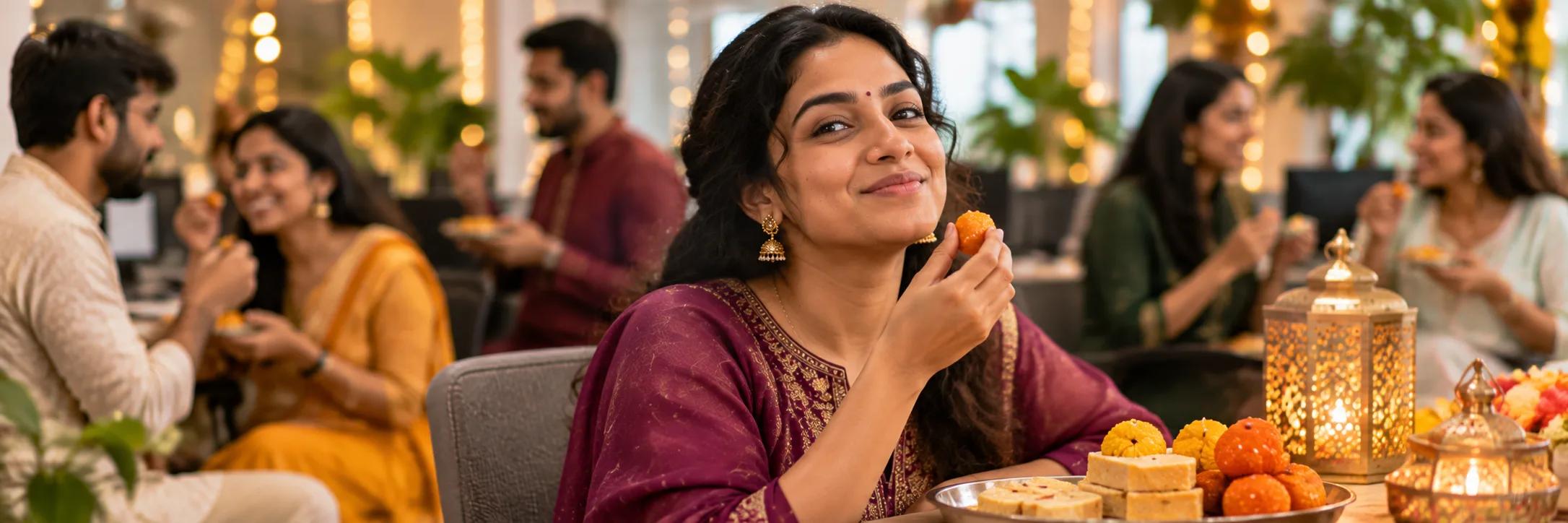
The sprint demo went well, and someone has left a box of kaju katli in the office pantry. By lunchtime, there's soan papdi on your desk, dry fruits from a client and an invitation to Friday's rooftop Diwali party. With sweets, team lunches and celebrations happening almost every day, it's easy to lose track of your usual eating routine. But office party eating doesn't have to mean avoiding your favourite foods or following strict rules. You can enjoy the gulab jamun you've been looking forward to, catch up with colleagues and still feel comfortable the next morning. A little planning can make festive celebrations easier to enjoy. From what you eat before leaving for the party to how you approach the buffet, choose drinks and return to your routine the following morning, small decisions can make a difference.
How much weight do the festive weeks really add?
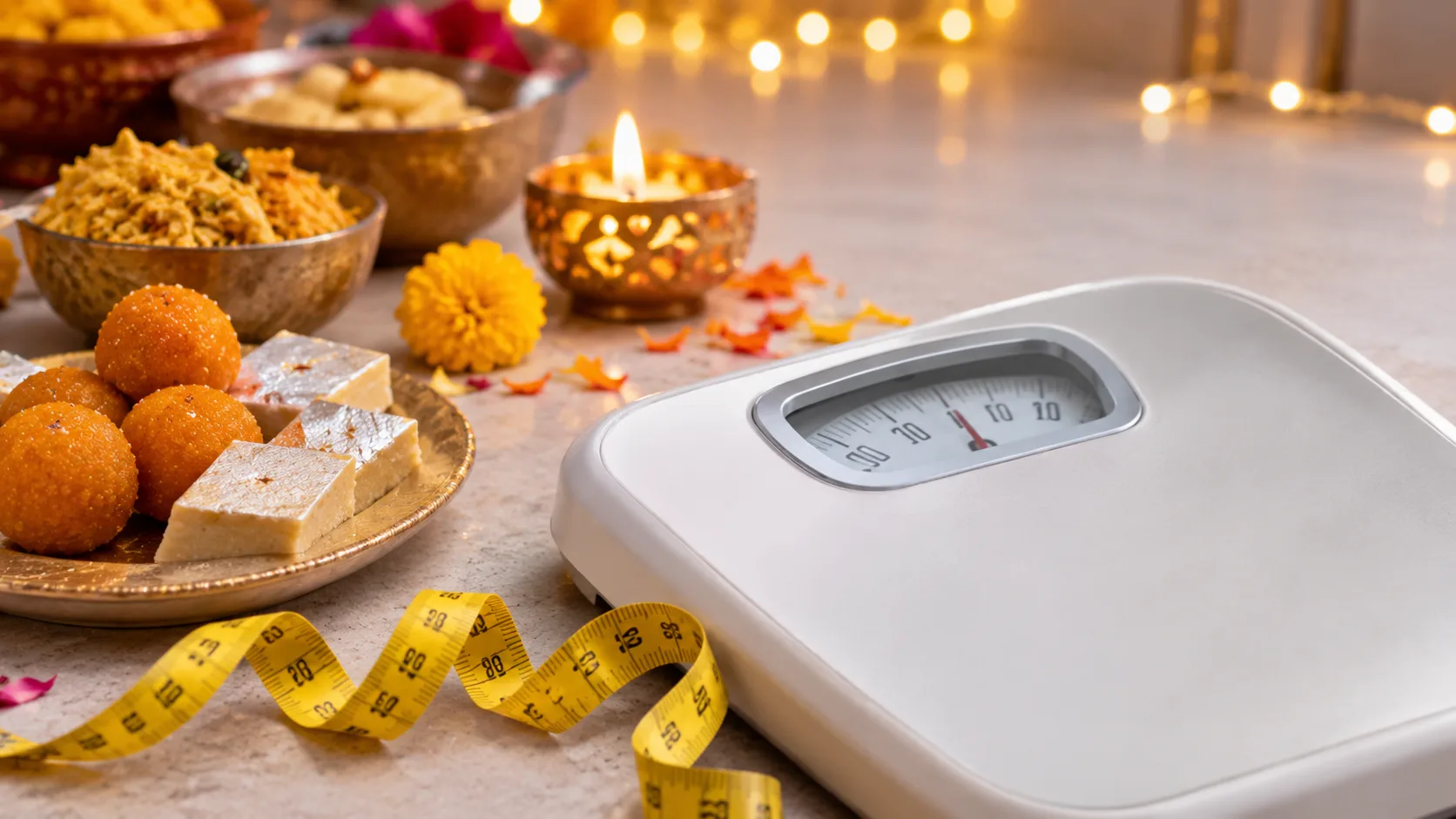
The festive weeks add less weight than people fear, though the gain tends to stay. A US study weighed a convenience sample of 195 adults across the autumn and winter. Over the main holiday stretch, the average gain was 0.37 kg, far below the popular claim of 2.3 kg or more. The catch came later. That gain was not reversed in the spring or summer, so the festive season left a small, lasting mark. The authors suggested this may be part of why adults slowly gain weight over the years.
A review of 39 studies on feasting periods around the world found that 70% of the 23 observational studies saw a significant rise in weight, with a mean gain of 0.7 kg. Half a kilo is not a crisis, but ten festive seasons of half a kilo each add up. A light routine through the season helps more than a guilty January. Small, mindful habits seem to make a difference. In a UK trial of 272 adults recruited partly through workplaces, people asked to weigh themselves often who also got simple tips for the festive period ended up about half a kilo lighter than people who got only a healthy living leaflet. The tips group stayed roughly level while the leaflet group gained.
Step 1: Before the party, do not arrive starving
It's tempting to skip lunch when you know there's a big office party in the evening. You tell yourself you're saving room for the buffet. But by the time the starters arrive, you're so hungry that you've already had several samosas before the party has properly begun. A little planning can help you enjoy the evening without arriving overly hungry.
Don't skip your usual lunch. A balanced meal of dal, rice or roti, sabzi and curd can help keep you satisfied through the afternoon. There's no need to eat less simply because you have a party later.
Have a light snack if you're hungry. Before leaving the office, try roasted chana, a fruit or a small bowl of sprouts from the cafeteria. Foods containing protein and fibre can help you feel satisfied until dinner.
Stay hydrated throughout the day. Have some water before heading to the party, particularly if you've been busy and haven't had much to drink. A small study involving 48 overweight adults aged 55 to 75 found that drinking 500 ml of water before main meals, alongside a calorie-controlled diet, was associated with approximately 2 kg greater weight loss over 12 weeks. However, these findings don't establish that drinking water before a party will prevent overeating. Staying comfortably hydrated is a sensible habit on its own.
Think about what you'd really like to eat. Maybe you've been looking forward to the rasmalai, or perhaps the biryani is your favourite part of the buffet. Knowing what you want to enjoy can make choosing your food easier, without setting strict rules or feeling you have to try everything.
Also read: Why do you feel hungry at night? Understand how sleep, stress and daily eating habits can influence late-night hunger.
Step 2: At the buffet, scan first and build your plate
With so many dishes laid out at an office party, it's tempting to put a little of everything on your plate. You want to enjoy the food, but you also don't want to leave feeling uncomfortably full. A few simple habits can help you find that balance.
Look around before serving yourself. Take a moment to see what's available. You might find that you'd rather enjoy your favourite biryani or paneer tikka than fill your plate with dishes you're not particularly interested in.
Build a balanced plate. The Harvard Healthy Eating Plate recommends filling half your plate with vegetables and fruit, one-quarter with whole grains and another quarter with healthy protein sources. At an Indian buffet, you could choose salad and vegetable sabzi, dal or tandoori paneer, and a portion of roti or pulao. It doesn't need to be an exact division at every celebration.
Start with one serving. Enjoy what's on your plate and give yourself a little time before deciding whether you'd like more. If you're still hungry, there's nothing wrong with taking another serving.
Make room for your favourite sweet. If you've been looking forward to the kaju katli or gulab jamun, enjoy it. Eating slowly and paying attention to the flavour can make the experience more satisfying.
Enjoy the conversations too. Once you've served yourself, find a comfortable place to sit or chat with colleagues. Moving away from the buffet can help you notice when you're eating out of hunger and when you're simply reaching for something nearby.
The same approach works when mithai boxes appear on every office desk during Diwali. You can enjoy a piece when you feel like having one without feeling you need to try everything at once.
Also read: Why do you crave sugar all the time? Discover 7 common reasons behind frequent sugar cravings.
What about team lunches and late dinners?
Team lunches can be just as enjoyable without having to sample every shared dish. Order something you genuinely like, include vegetables or raita where possible, and share a dessert if that appeals to you.
Late dinners after a client meeting or a long workday can feel different, especially when you're already tired and hungry. If the menu offers soup or salad, you can start with that before choosing your main course. Grilled or tandoori dishes are useful options when you prefer something less oily, but you don't have to avoid your favourites.
Also read: Why do you feel tired after eating? Understand what may cause sleepiness after a heavy meal and when it deserves attention.
Step 3: With drinks, keep water in your hand
You don't need to drink alcohol to enjoy an office party or feel included in the celebrations. Whether you choose to drink is entirely up to you, and it's perfectly fine to stick with lime soda, water or another non-alcoholic drink. If you do choose to drink, the NHS recommends a few practical ways to reduce your alcohol intake:
Set a limit for yourself before the party begins.
Have something to eat before drinking.
Alternate alcoholic drinks with water or other non-alcoholic options.
Choose smaller servings or drinks with lower alcohol content.
It's also worth understanding the health risks. According to the World Health Organization (WHO), no level of alcohol consumption is completely risk-free. Alcohol is classified as a Group 1 carcinogen, meaning there is sufficient evidence that it can cause cancer in humans. Drinking less generally reduces alcohol-related health risks.
How can you politely decline a drink?
Sometimes a colleague offers you a drink simply to be friendly. You don't need a long explanation if you'd rather not have one. A few natural responses can make the conversation easier:
"I'm happy with my lime soda, thanks."
"I've got an early client call tomorrow."
"I'm driving tonight, so I'll stick to something non-alcoholic."
"Not tonight, thanks. Come on, let's get a team photo!"
Having a drink you enjoy already in your hand can also make these conversations easier. Most importantly, choose what feels comfortable for you. If you take regular medication or have a medical condition, check with your doctor about whether drinking alcohol is appropriate, since alcohol can interact with certain medicines.
Step 4: The next morning, get back to normal
After an evening of good food and celebrations, there's no need to skip meals or follow a strict diet the next day. A few simple habits can help you return to your usual routine.
Take a gentle walk. A short walk after a meal can support digestion and help your body manage post-meal blood sugar levels. Also read: Can walking after meals help blood sugar? Understand the benefits of light movement after eating.
Stay hydrated. Drink water regularly throughout the morning, especially if you had alcohol or haven't had enough fluids. Salty foods may also leave you feeling thirstier than usual.
Return to your normal meals. Enjoy your usual breakfast and lunch rather than skipping meals to compensate for the previous evening. Balanced meals can help you manage hunger and maintain steady energy throughout the day.
Keep things simple. You don't need special detox drinks or restrictive cleanses after a party. Your liver and kidneys naturally process and remove waste. Regular meals, adequate fluids and rest are sensible ways to support your body.
Look at your habits over time. If you're managing your weight, occasional self-weighing may help you monitor longer-term trends. Daily fluctuations are normal, though, and weighing yourself isn't essential. Choose an approach that feels comfortable and supports your health.
When should you see a doctor?

The heavy feeling after a big party usually passes on its own. See a doctor if you are worried or it is not getting better, for example heartburn, bloating or stomach pain that lasts for days, or vomiting that will not stop. Talk to a doctor too if you worry about how much you drink or feel unable to stop once you start.
Some signs need emergency help:
If you vomit blood, the NHS says you should always get medical help. Call 112 or go to the emergency department if you are vomiting blood and feel generally unwell, confused, faint or dizzy, have rapid or shallow breathing, have cold, clammy, pale skin, have tummy pain or have black poo. If you have stopped vomiting blood and have no other symptoms, it advises an urgent GP appointment (NHS, Vomiting blood).
For bleeding from the bottom, the NHS advises an urgent GP appointment if your poo is black or dark red or you have bloody diarrhoea. Go to the emergency department or call 112 if you are bleeding non-stop or there is a lot of blood (NHS, Bleeding from the bottom).
For chest pain, call 112 if you get sudden pain or discomfort in your chest that does not go away, pain that spreads to your left or right arm, or your neck, jaw, stomach or back, or chest pain with feeling sweaty, sick, light headed or short of breath (NHS, Chest pain).
If you have diabetes, call 112 or go to the emergency department if you think your sugar is high and you are feeling sick, being sick or have stomach pain, are breathing or your heart is beating faster than usual, feel drowsy or are struggling to stay awake, have breath with a fruity smell, feel confused or have difficulty concentrating, or have a high level of ketones in your blood or pee (NHS, High blood sugar).
If you take medicines for diabetes, blood pressure or anything else, ask your doctor how to handle big meals and drinks. Do not change any dose on your own.
The routine on one screen
Before: eat lunch, have a small snack, drink water, decide one thing.
At the buffet: scan first, use the plate method, pick one sweet you love.
With drinks: water between drinks, a polite no ready and a word with your doctor first if you take regular medicine.
The next morning: walk, drink water, eat normal meals and skip the detox.
Diwali at work is about the people. The sweets are a lovely part of it. So take the kaju katli from the box on your teammate's desk, stand by the window with your team watching the lights come on across the city and save the second helping for the friend who stayed late to fix your build.
Sources
A prospective study of holiday weight gain (New England Journal of Medicine, 2000)
Healthy Eating Plate (Harvard T.H. Chan School of Public Health)
No level of alcohol consumption is safe for our health (WHO Europe, 2023)
Medical Disclaimer: This article is for general information and is not a substitute for advice from your doctor. Speak to a qualified healthcare professional before starting any supplement, especially if you are pregnant, breastfeeding or taking medication.
Continue this topic
Connected guides, ingredient explainers, product context, and tools chosen from this article's topic cluster.
Quick questions
How much weight do people gain over the festive season?
People gain less than the popular claim of 2.3 kg or more. In a US study of 195 adults the average gain over the main holiday stretch was 0.37 kg. That gain was not reversed in the months that followed, so small habits during the season are worth it.
Should I skip lunch before an office party?
It is better not to skip lunch. Arriving very hungry makes it easy to overeat the starters. Eat your normal lunch, have a small snack before you leave and drink a glass of water on the way.
How do I handle the mithai boxes on every desk at work?
Pick one piece you truly love and enjoy it slowly. Leave the rest. You do not need to try every box that lands on the floor in October.
How can I say no to a drink at a work party?
Keep a glass of lime soda or water in your hand and use a short line such as "I have an early client call tomorrow" or "I am driving tonight". Many people will not ask twice.
Do I need a detox after a Diwali party?
You do not need a detox. Your liver and kidneys already clear what you ate and drank. Go for a walk, drink water and return to your normal meals. See a doctor if stomach pain or heartburn lasts for days or is not getting better.
11 linked sources checked against our citation and claim-safety process.
Reviewed 7 Nov 2026 for supplement-claim and medical-disclaimer boundaries.
Recommended from the Aora range
Aora Nutrivit Plus
19 Essential Nutrients with Zinc, Magnesium and Vitamins B Complex, C and D3
- Multivitamin
- Daily Foundation
- Made in India
From₹690
Try Aora - free
Put this article to work on you.
Health and safety notice
- This article is educational. It is not medical advice and is not a substitute for guidance from a qualified healthcare provider. Consult a physician before starting any supplement, especially during pregnancy or breastfeeding, with a medical condition, or while on medication.
- FSSAI compliance: Health supplements and nutraceuticals are not intended for medicinal use. Any supplement-related information is provided to describe nutritional or physiological support and should not be interpreted as a claim to diagnose, treat, cure, or prevent any disease. FSSAI regulates health supplements and nutraceuticals separately from medicinal products.
Read our full medical disclaimer and editorial policy.
Sources and editorial standards
- 1average gain was 0.37 kg
- 270% of the 23 observational studies saw a significant rise in weight
- 3ended up about half a kilo lighter
- 4small study involving 48 overweight adults aged 55 to 75
- 5Harvard Healthy Eating Plate
- 6NHS recommends
- 7World Health Organization (WHO)
- 8NHS, Vomiting blood
- 9NHS, Bleeding from the bottom
- 10NHS, Chest pain
- 11NHS, High blood sugar
Supplement content is educational only and should not replace medical advice from a qualified clinician. Product mentions are reviewed for claim safety before publication.