
10 Small Healthy Habits for Better Everyday Wellbeing
Build healthier routines with 10 small daily habits that support energy, digestion, sleep and overall wellbeing without unrealistic overhauls.

In this article(16 sections)
- What are small healthy habits?
- Why do small healthy habits matter?
- 10 small healthy habits for better everyday wellbeing
- 1. Build a regular meal rhythm
- 2. Add one more colour to your plate
- 3. Give every main meal a protein anchor
- 4. Link drinking water to something you already do
- 5. Add movement between everyday tasks
- 6. Break up long periods of sitting
- 7. Create a repeatable sleep cue
- 8. Give stress somewhere to go
- 9. Take one routine outdoors
- 10. Review what is already in your supplement cabinet
- How can you make healthy habits stick?
- How long does it take to build a healthy habit?
- Medical Disclaimer
We have all had those mornings. Your alarm goes off early for a work call, so you skip breakfast. By lunchtime, you are eating at your desk while staring at a screen. Your water bottle is still untouched at 4 pm, and the only real movement you have had all day is the short walk to your car. Then you finally get into bed and delay sleep by another hour because you just want some time to scroll. When people think about taking charge of their health, they often imagine strict diets, exhausting workouts or a complete lifestyle overhaul. But small healthy habits are easier to fit into busy days. Taking care of your health does not require a flawless morning routine. It is built through everyday decisions that fit the life you are living right now.
What are small healthy habits?
Small healthy habits are repeatable actions that support your physical and mental wellbeing without requiring a complete routine change. They can be as simple as adding a fruit to lunch, walking for five minutes after a meeting or dimming the lights before bed. The aim is not to create a perfect day. It is to choose actions that are realistic enough to repeat when you are busy or tired.
Why do small healthy habits matter?
Health is rarely shaped by one part of your day. Sleep can influence appetite and food choices, long periods of sitting reduce daily movement, and stress can affect sleep and appetite. A new habit needs to fit into your busy Tuesday, not just a quiet Sunday afternoon. Research on habit formation also suggests that repeating an action in a consistent context helps it become more automatic over time.
10 small healthy habits for better everyday wellbeing
Keep it simple. You do not have to do all ten. Start with one or two that fit easily into your day and build from there.
1. Build a regular meal rhythm
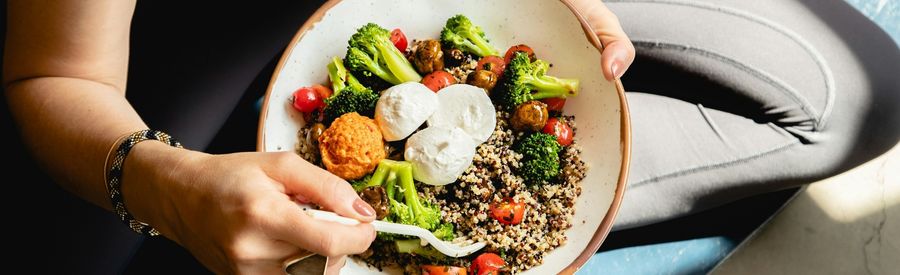
It is difficult to maintain a consistent eating schedule when you are balancing work and personal life. Many of us skip breakfast, eat lunch late or end up having a large meal late in the evening. You do not need to eat every three hours or follow rigid meal times. A practical place to start is a rough window for your main meals. It can make balanced meals easier to plan and help you avoid reaching the next meal extremely hungry.
Make it smaller: Set a rough window for one meal.
Attach it to: An unavoidable break in your workday.
Try it today: Decide when you will step away from your desk for lunch tomorrow.
For a deeper look at meal timing, read The Best Time to Eat for Digestion, Energy and Weight Control.
2. Add one more colour to your plate
When you are tired, it is easy to eat the same meals every day. Adding more variety can help you get a wider range of nutrients. The Food and Agriculture Organization of the United Nations (FAO) uses dietary diversity as a practical indicator of diet quality and nutrient adequacy. You do not need to completely change the way you eat. Even one extra fruit or vegetable is a useful place to start.
Make it smaller: Add one extra fruit or vegetable to one meal.
Attach it to: Dinner preparation or your morning commute.
Try it today: Add spinach to your eggs, a vegetable to lunch or a piece of fruit to your usual snack.
For more on food quality and nutrient density, read Is Our Food Becoming Less Nutritious? What Science Really Says.
3. Give every main meal a protein anchor
We often plan meals around carbohydrates such as rice or roti and think about the rest of the plate afterwards. Protein is needed for maintaining muscle and many basic functions throughout the body, and it can also help a meal feel more satisfying. You do not need a complicated high-protein diet. Start with a practical source such as dal, beans, curd, eggs, fish, chicken, paneer or tofu, depending on what you eat.
Make it smaller: Choose the protein source before planning the rest of the meal.
Attach it to: Your grocery list or weekly meal planning.
Try it today: Add curd, lentils, eggs or tofu to your next meal.
4. Link drinking water to something you already do
We all know we need water, but somehow the bottle can sit on the desk untouched for hours. How much fluid you need varies with the weather, activity, food intake and your health. The European Food Safety Authority (EFSA) recognises water as necessary for maintaining normal physical and cognitive functions. Rather than forcing yourself to finish a huge bottle at once, make water part of moments that already happen in your day.
Make it smaller: Start with one extra glass of water.
Attach it to: Finishing tea or coffee, returning to your desk or ending a meeting.
Try it today: Drink a glass of water after your first tea or coffee.
5. Add movement between everyday tasks
When you are glued to a laptop all day, even the idea of a 30-minute workout can feel overwhelming. The World Health Organization (WHO) recommends regular physical activity and notes that some activity is better than none. People who are inactive can start with small amounts and build up gradually. A five-minute walk is not the whole weekly activity target, but it is a realistic starting point.
Make it smaller: Walk for five minutes.
Attach it to: Lunch, a phone call or the end of a meeting.
Try it today: Take one phone call while walking around your room, office or building.
6. Break up long periods of sitting
Moving more and sitting less are related, but they are not exactly the same thing. The WHO also recommends limiting sedentary time and replacing some of it with physical activity of any intensity. If you sit for most of the workday, look for small reasons to stand, stretch or walk instead of waiting for a formal workout.
Make it smaller: Stand up for one minute.
Attach it to: Sending a long email, refilling your water or finishing a task.
Try it today: Stand up, stretch and walk around for a minute before your next task.

7. Create a repeatable sleep cue
After a long day, it is tempting to get into bed and scroll until you feel sleepy. The American Academy of Sleep Medicine (AASM) and Sleep Research Society (SRS) recommend that healthy adults regularly get seven or more hours of sleep a night. A repeatable wind-down cue will not fix every sleep problem, but it can make the end of the day feel more predictable.
Make it smaller: Dim bright lights about 30 minutes before bed.
Attach it to: Brushing your teeth or finishing your last task.
Try it today: Give yourself one short screen-free period before bed.
8. Give stress somewhere to go
Most people deal with stress from work, money, relationships or family responsibilities. You may not be able to remove every source of stress, but it helps to have a simple way to shift out of work mode. A short walk, a hobby, slow breathing or a few quiet minutes can give the day a clear pause instead of carrying the same tension straight into the evening.
Make it smaller: Practise slow breathing for two minutes.
Attach it to: Your commute home or the moment you close your laptop.
Try it today: Take five slow breaths before opening your inbox tomorrow morning.
9. Take one routine outdoors
Between commuting, office work and relaxing at home, it is easy to spend most of the day indoors. You do not need a long hike or a complicated outdoor routine. Moving one everyday activity outside can give you a break from your screen and naturally add a little movement.
Make it smaller: Spend five minutes outside.
Attach it to: Tea, coffee, lunch or a regular phone call.
Try it today: Take your morning drink outside or step onto the balcony for a few minutes.
10. Review what is already in your supplement cabinet
When we feel tired or run down, it is easy to add another supplement without checking what we already take. Using several products can lead to overlapping vitamins, minerals or other ingredients. Supplements should complement food and everyday habits, not replace them. Check the serving size, ingredient amounts, warnings and whether two products contain the same nutrients.
Make it smaller: Read the full label of one supplement you already use.
Attach it to: Your weekend cleaning or organising routine.
Try it today: Check one bottle for serving size, duplicate nutrients and any warnings that apply to you.
If you take regular medication, are pregnant or breastfeeding, or manage a health condition, ask a qualified healthcare professional before adding or changing supplements.
How can you make healthy habits stick?
Knowing what to do is often easier than doing it at the end of a long day. The National Institutes of Health (NIH) recommends practical strategies such as setting realistic goals, changing your surroundings to make healthier choices easier, tracking progress and expecting setbacks.
Start with one habit: Do not try to fix your water intake, sleep and exercise on the same Monday.
Make it easy: If a 30-minute walk feels unrealistic, start with five minutes.
Use a stable cue: Link the action to something you already do, such as making tea, eating lunch or brushing your teeth.
Prepare the environment: Put your walking shoes where you can see them or keep water within easy reach.
Track completion, not perfection: A shorter version of the habit still counts.
Restart quickly: Missing a day does not mean the routine has failed. Continue at the next opportunity.
How long does it take to build a healthy habit?
There is no magic number. A University College London study published in the European Journal of Social Psychology followed 96 people as they repeated a chosen eating, drinking or activity behaviour in the same context for 12 weeks. Among participants whose data could be modelled, the estimated time to reach near-maximum automaticity ranged from 18 to 254 days, with an average of about 66 days.
That does not mean every habit takes 66 days. A glass of water after breakfast and a regular exercise routine are very different behaviours. The more useful lesson is that habits take different amounts of time, repetition in a consistent context matters, and missing one opportunity did not materially derail the habit-formation process.
Medical Disclaimer
This article is for general educational purposes only and should not replace professional medical advice, diagnosis or treatment. If tiredness, digestive symptoms, poor sleep or other concerns are persistent, severe or worsening, seek medical advice rather than relying only on lifestyle changes.
Continue this topic
Connected guides, ingredient explainers, product context, and tools chosen from this article's topic cluster.
Sleep quality, magnesium, stress, recovery, evening routines
Relevant for daily micronutrient coverage alongside sleep and stress routines.
Gummies, cortisol reels and sleep blends. What ashwagandha trials really show for stress and sleep, the liver and thyroid warnings and how to choose safely.
Skipped breakfasts, midnight noodles and cup after cup of chai. A calm guide to eating, drinking and sleeping well through exam season.
Getting sick often does not automatically mean you have a weak immune system. Exposure, poor sleep, stress, smoking, nutrition and some health conditions can all play a part.
Quick questions
What are 10 healthy habits to do every day?
Useful everyday habits can include regular meals, more varied fruits and vegetables, a source of protein with meals, regular hydration, daily movement, less sitting, a repeatable sleep routine, time to unwind, some time outdoors and checking supplements carefully. You do not need to do all ten perfectly every day.
How do I start a healthy daily routine?
Start with one action that is easy enough to repeat. Choose a clear cue, such as drinking water after your morning tea or walking for five minutes after lunch. Once it feels like a normal part of the day, add another habit.
How long does it take to form a healthy habit?
There is no fixed timeline. In the University College London study described above, the estimated time varied widely from 18 to 254 days, with an average of around 66 days. The behaviour and the person both matter.
Should I start several healthy habits at once?
You can, but you do not have to. If changing food, exercise, sleep and hydration together feels overwhelming, start with one or two. A smaller routine that you can repeat is more useful than a long checklist that lasts only a few days.
6 linked sources checked against our citation and claim-safety process.
Reviewed 29 Aug 2026 for supplement-claim and medical-disclaimer boundaries.
Recommended from the Aora range
Aora Nutrivit Plus
19 Essential Nutrients with Zinc, Magnesium and Vitamins B Complex, C and D3
- Multivitamin
- Daily Foundation
- Made in India
From₹690.00
Try Aora - free
Put this article to work on you.
Health and safety notice
- This article is educational. It is not medical advice and is not a substitute for guidance from a qualified healthcare provider. Consult a physician before starting any supplement, especially during pregnancy or breastfeeding, with a medical condition, or while on medication.
- FSSAI compliance: Health supplements and nutraceuticals are not intended for medicinal use. Any supplement-related information is provided to describe nutritional or physiological support and should not be interpreted as a claim to diagnose, treat, cure, or prevent any disease. FSSAI regulates health supplements and nutraceuticals separately from medicinal products.
Read our full medical disclaimer and editorial policy.
Sources and editorial standards
- 1Food and Agriculture Organization of the United Nations (FAO)
- 2European Food Safety Authority (EFSA)
- 3World Health Organization (WHO)
- 4American Academy of Sleep Medicine (AASM) and Sleep Research Society (SRS)
- 5National Institutes of Health (NIH)
- 6University College London study published in the European Journal of Social Psychology
Supplement content is educational only and should not replace medical advice from a qualified clinician. Product mentions are reviewed for claim safety before publication.