Pollution Hair Damage: What Smog Season Does to Your Scalp
Smog particles stick to your hair and scalp every winter. What the research shows and the simple washing, covering and food habits that help.

In this article(8 sections)
It is the second week of November. The sky over your city has been a flat grey since morning, your eyes sting on the ride home and when you run your fingers through your hair at night it feels like dry straw. Pollution hair damage is the name many people give to this feeling. It is real: fine smog particles settle on the hair shaft, dull its shine, roughen its surface and may irritate the scalp underneath. The good news is that most of this sits on the outside of your hair. Clean habits, a little protection and steady nutrition for the hair that is still growing can make smog season far easier on your head.
What smog leaves behind on your hair

Smog is a mix of gases and tiny particles. The particles are called particulate matter, or PM. PM2.5 means particles smaller than 2.5 micrometres, small enough to stay suspended in the air we breathe. The World Health Organization says that in 2019, 99% of the world's population lived in places where its air quality guideline levels were not met-air-quality-and-health). For anyone living in north India, that number will not come as a surprise in November.
It sticks to the hair shaft
Researchers wanted to know what actually lands on hair in a badly polluted city. In one study, hair swatches were left out for 24 to 72 hours in a severely polluted environment in Baoding, China, then checked under a scanning electron microscope. A large number of particles of various sizes had settled on the hair surface. More particles stuck when the hair was coated in sebum, the natural oil from your scalp. More also stuck the longer the hair was exposed. The exposed hair lost a measurable amount of shine. Its surface friction went up, which means the strands felt rougher and dragged against each other. The researchers also found metals such as aluminium, iron, copper, barium and zinc on the exposed hair. Their estimate was that billions of particles can sit on a full head of hair for someone living in a severely polluted place.
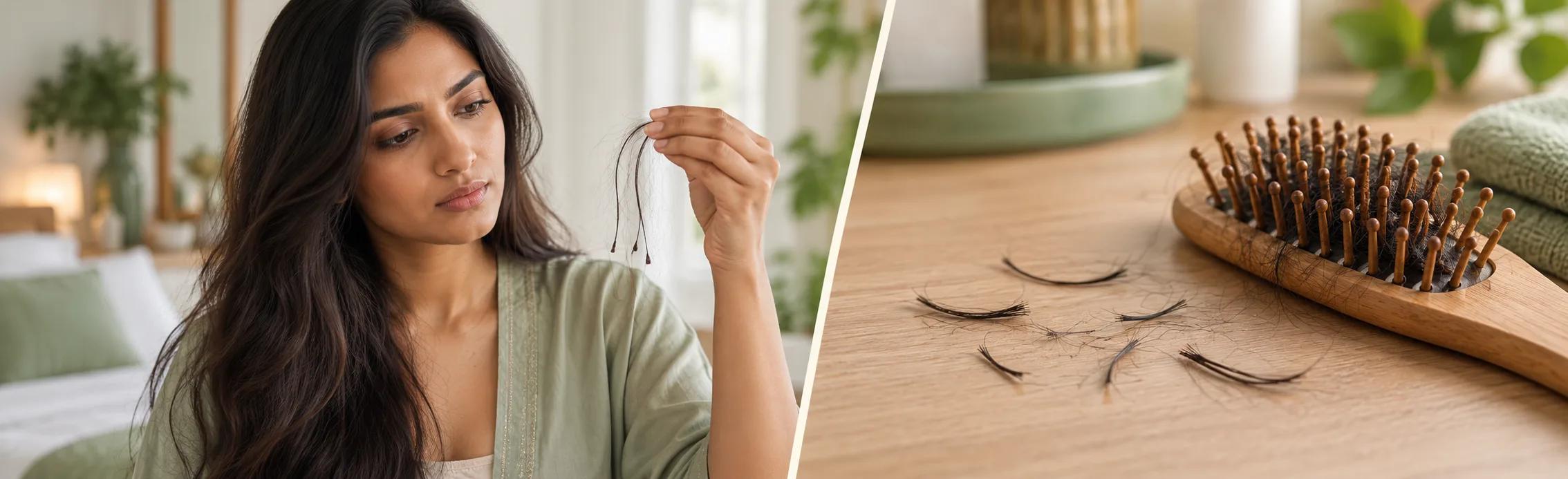
That rough, dull feel you notice in winter is exactly what this study measured. Rougher strands also tangle more easily. Tangled hair breaks when you comb it, which is why smog season can look like more hair fall when much of it is really snapped strands. Our Aora guide on hair shedding vs hair breakage shows you how to tell the two apart by looking at the fallen hair.
What about the scalp and the roots?
The scalp is skin, so it takes the same hit as your face. In a laboratory study, researchers exposed hair follicles taken from human scalp to particulate matter. The particles caused cell death in the follicle's keratinocytes, raised reactive oxygen species and switched on inflammatory signals. Reactive oxygen species are unstable molecules that damage cells, a process called oxidative stress. The authors concluded that particles reaching the follicle could impair hair growth.
This was work on follicles in a dish, not on people walking through Delhi traffic. Still, it fits a wider picture. A 2024 review of air pollution and skin disease lists oxidative stress, damage to the skin barrier, changes in the skin's microbes and inflammation as the main ways pollutants affect skin. The same review names hair loss among the skin conditions linked to air pollution. In daily life this often shows up as an itchy scalp, small flakes and a greasy feeling at the roots only a day after washing.
Why does your hair feel worse every November?
Several things pile up at once in North Indian winters.
Cold, still air keeps smoke and dust close to the ground, so each breath and each hour outdoors carries more particles.
Festival crackers, crop residue burning and traffic all add to the load in the same few weeks.
Dry winter air pulls moisture from the hair, so the cuticle is already rough before the smog settles on it.
Hot water baths feel lovely on a cold morning but strip natural oils from the scalp and lengths.
Oiled hair worn outdoors gives particles more to cling to, since the study above found oil on the hair surface increased how much stuck.
That last point matters for many Indian homes where a weekly champi is a family ritual. You do not have to give it up. Change the timing.
Washing, oiling and covering: habits that help
Think of your hair care in smog season as removing what lands on it before it builds up. The American Academy of Dermatology suggests that you wash your hair based on how quickly it gets dirty or oily and apply shampoo mainly to the scalp rather than scrubbing the whole length.
Wash more often on bad air days. If you ride a two wheeler or walk to the metro, a wash every second day or even daily is reasonable for an oily scalp. Use a mild shampoo.
Use lukewarm water. Very hot water makes dry, rough hair worse.
Condition the lengths every time. Conditioner smooths the cuticle and cuts the friction the study measured.
Oil before you wash, not before you step out. Apply oil for an hour or overnight at home, then shampoo it out in the morning.
Cover your hair outdoors. A cotton scarf, a dupatta or a cap keeps much of the dust off. Wash the cloth often, since it collects the same grime.
Keep your helmet clean. Wash or replace the inner lining so you are not pressing old dirt onto your scalp every day.
Comb gently. Use a wide-tooth comb on damp hair and start from the ends.
Change pillow covers once or twice a week in smog season.
If breakage is your main worry, our list of ways to prevent hair breakage goes into styling, heat and tying habits in more detail.
Can food help the new hair grow stronger?

The hair you can see is no longer alive. It is a fibre made mostly of keratin, a protein. What you eat today shapes the new hair being made inside the follicle, not the old strand outside. Follicles are among the busiest parts of the body. A review on vitamins, minerals and hair loss describes how the matrix cells at the base of the follicle divide rapidly, with micronutrients playing a major role in the normal hair cycle. The review discusses vitamins A, B, C, D and E with iron, selenium and zinc. It describes a shortfall in these as a possible risk factor you can change. A winter plate that feeds hair might look like this:
Protein at every meal: dal, rajma, chana, paneer, curd, eggs, fish or chicken
Iron sources: green leafy vegetables, ragi, bajra, jaggery in small amounts, with lemon or amla to help absorption
Zinc sources: pumpkin seeds, sesame, whole grains and legumes
Vitamin C from amla, guava, oranges and tomatoes, which are all in season
Healthy fats from nuts, seeds and a little ghee or cold-pressed oil for vitamin E and A
If your meals in this busy season are rushed, a daily formula can help fill the gaps. Aora Chamrose is a daily hair nutrition formula that brings together biotin, the amino acids lysine, cysteine, methionine and arginine, iron, zinc, vitamins A, C, D3, E, B2 and B12, plus chamomile, rosemary and jatamansi extracts. Think of it as a set of building blocks for the new hair your follicles are making right now. Our article on whether hair growth supplements work explains how to get the most from any hair nutrition routine.
Clean habits and a good plate remain the base of healthy hair in any season.
When should you see a dermatologist?
Most smog season dullness and dryness settle with good care. Book a visit if you notice any of these:
Round bald patches or a widening parting
Heavy shedding that continues long after the smog has cleared
A red, painful or weeping scalp, or thick yellow scales
Itching bad enough to wake you at night or make the scalp bleed
Hair fall along with tiredness, weight change, breathlessness or heavy periods, which can point to low iron, thyroid problems or other conditions your doctor can test for
If you take regular medication or are pregnant, ask your doctor before you start any new supplement. By February, the air will turn blue again. The hair that grows through these winter weeks is being built now, from the food on your plate and the care you give your scalp each evening, so treat those small habits as an investment in the hair to come.
Sources
Ambient (outdoor) air pollution fact sheet (World Health Organization)-air-quality-and-health)
Particulate Matters Induce Apoptosis in Human Hair Follicular Keratinocytes (Ann Dermatol, 2020)
The Role of Vitamins and Minerals in Hair Loss: A Review (Dermatol Ther, 2019)
Medical Disclaimer: This article is for general information and is not a substitute for advice from your doctor. Speak to a qualified healthcare professional before starting any supplement, especially if you are pregnant, breastfeeding or taking medication.
Continue this topic
Connected guides, ingredient explainers, product context, and tools chosen from this article's topic cluster.
A plain guide to keratin: the layers of a hair strand, the sulphur bonds that make it strong and how nutrition builds new hair.
Hair on your pillow, brush or bathroom floor does not always mean the same thing. Learn the signs that can help you tell increased shedding from hair breakage.
Learn how to prevent hair breakage with practical advice on washing, conditioning, detangling, heat styling and spotting when hair changes need checking.
Quick questions
Can air pollution cause hair fall?
Laboratory research shows that fine particles can harm cells in the hair follicle through oxidative stress and inflammation. In daily life, much of the extra hair you see in smog season is often breakage from rough, tangled strands. Heavy or patchy hair loss needs a dermatologist.
How often should I wash my hair in smog season?
Wash based on how quickly your scalp gets oily or dirty. If you spend time outdoors on bad air days, washing every second day or daily with a mild shampoo is reasonable for an oily scalp. Condition the lengths each time.
Is it bad to oil my hair when pollution is high?
Oil on the hair surface helps particles stick, so avoid stepping out with oiled hair. Oil at home for an hour or overnight, then shampoo it out before you go outdoors.
Does covering my hair protect it from pollution?
A cotton scarf, dupatta or cap keeps much of the dust off your hair while you travel. Wash the cloth and your helmet lining often because they collect the same grime.
What should I eat to support hair growth in winter?
Eat protein at every meal from dal, paneer, curd, eggs or fish. Add iron from greens and millets with vitamin C from amla or guava. Zinc from seeds and legumes also matters because follicle cells divide quickly and need steady nutrition.
6 linked sources checked against our citation and claim-safety process.
Reviewed 7 Oct 2026 for supplement-claim and medical-disclaimer boundaries.
Recommended from the Aora range
Aora Chamrose
Chamomile, Rosemary & Jatamansi Extract
- Hair Care
- Hair Support
- Made in India
From₹960.00
Try Aora - free
Put this article to work on you.
Health and safety notice
- This article is educational. It is not medical advice and is not a substitute for guidance from a qualified healthcare provider. Consult a physician before starting any supplement, especially during pregnancy or breastfeeding, with a medical condition, or while on medication.
- FSSAI compliance: Health supplements and nutraceuticals are not intended for medicinal use. Any supplement-related information is provided to describe nutritional or physiological support and should not be interpreted as a claim to diagnose, treat, cure, or prevent any disease. FSSAI regulates health supplements and nutraceuticals separately from medicinal products.
Read our full medical disclaimer and editorial policy.
Sources and editorial standards
- 199% of the world's population lived in places where its air quality guideline levels were not met
- 2A large number of particles of various sizes had settled on the hair surface
- 3The particles caused cell death in the follicle's keratinocytes, raised reactive oxygen species and switched on inflammatory signals
- 4oxidative stress, damage to the skin barrier, changes in the skin's microbes and inflammation
- 5wash your hair based on how quickly it gets dirty or oily and apply shampoo mainly to the scalp
- 6matrix cells at the base of the follicle divide rapidly, with micronutrients playing a major role in the normal hair cycle
Supplement content is educational only and should not replace medical advice from a qualified clinician. Product mentions are reviewed for claim safety before publication.