What Is Keratin? How Your Hair Is Built and Why It Breaks
A plain guide to keratin: the layers of a hair strand, the sulphur bonds that make it strong and how nutrition builds new hair.

In this article(12 sections)
What is keratin? Keratin is the tough, fibrous protein that makes up your hair, the outer layer of your skin and your nails. Each hair strand is mostly keratin, packed into long chains that are tied together by strong sulphur bonds. Those bonds give hair its strength, its shape and its ability to stretch without snapping. Keratin is also what heat, bleach and chemical treatments damage. It is also what your follicles rebuild every day from the protein you eat. You might have seen the word on shampoo bottles, salon boards and supplement labels. Keratin smoothing, keratin repair, keratin boost. You see these words on shampoos, conditioners and salon menus so often that keratin starts to sound like something you put on your hair. But your hair is already made mostly of keratin, a protein your body produces naturally. So what does keratin actually do, why does hair get damaged, and where does nutrition fit in? It starts with understanding how your hair is built.
Keratin in one paragraph
Keratin belongs to a group of proteins called intermediate filaments, which give cells their structure. A review of human hair keratins in the Journal of Investigative Dermatology explains that hair keratins are "hard" keratins. They differ from the "soft" keratins in skin. The key difference is cysteine, a sulphur-containing amino acid. Hair keratin contains about 7.6% cysteine compared with 2.9% in skin keratin. That extra cysteine lets hair form many more disulphide bonds, which makes it tougher and more durable.
How is a hair strand built?
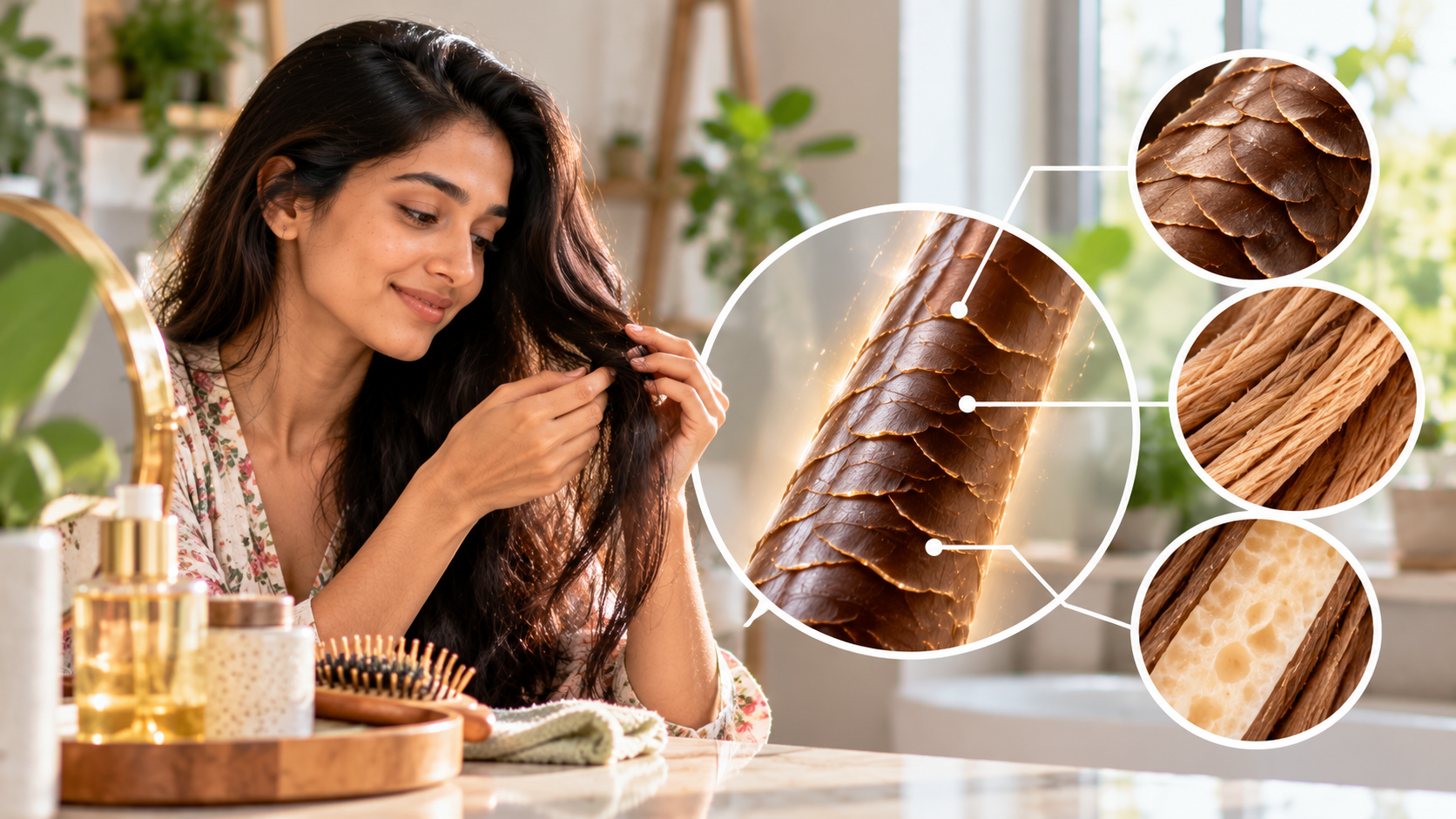
Hair grows from a follicle, a small pocket in the skin of your scalp. At the base of the follicle, cells divide quickly, fill up with keratin and then harden as they move upward. A review of hair structure and chemical straightening in the International Journal of Cosmetic Science notes that the hair fibre you see is made of these hardened, non-living cells. A single strand has three layers, a bit like a pencil.
The cuticle
This is the outer coat. It is made of flat, overlapping cells arranged like roof tiles or fish scales. A smooth, flat cuticle reflects light, which is why healthy hair looks shiny. When the cuticle lifts or chips, hair looks dull and feels rough. It also tangles more easily.
The cortex
This is the thick middle layer and the main body of the hair. It is packed with bundles of keratin fibres held together by bonds. The cortex decides how strong your hair is and how much it can stretch. It also carries melanin, the pigment that gives hair its colour.
The medulla
This is a soft, loosely packed core at the very centre. It is often present in thick hair and may be patchy or missing in fine hair. It plays a small role compared with the cortex.
What role do cysteine and disulphide bonds play?
Think of the keratin chains in your cortex as ropes. On their own, they would slide past each other. Disulphide bonds act like knots between the ropes. Each one forms when two cysteine units on nearby chains join through their sulphur atoms. These bonds do three things:
They give hair its strength and resistance to pulling.
They hold your natural curl or wave in place. The pattern of bonds is set inside the follicle as the hair forms.
They make hair resistant to water. A wash does not undo them.
Hair also contains weaker hydrogen bonds that break when it gets wet and form again as it dries. That is why a blow-dry or braiding damp hair can temporarily change its shape, usually until the next wash. Stronger disulphide bonds, on the other hand, depend on sulphur, which comes from amino acids such as cysteine and methionine. Your body gets these through dietary protein. This is one reason eating enough protein matters for healthy hair growth, although it cannot repair damage to hair that has already grown.
Why do heat and chemicals damage keratin?
Keratin is strong, but it is not unbreakable. Most damage comes from three sources. Heat. Flat irons and curling tongs work by softening keratin so it can be reshaped. A study of thermal styling in the Journal of Cosmetic Science found that the onset of damage is strongly dependent on temperature. Higher heat does far more harm. The American Academy of Dermatology advises limiting blow-drying and hot tools, using low or medium settings and applying a heat protectant.
Colour and perms. A 2023 review in Frontiers in Medicine explains that hair dyes and perms change the colour or shape of hair by altering the physical structure and chemistry of the hair shaft. Bleach opens the cuticle and oxidises the inside of the strand. Perms and chemical straighteners break disulphide bonds on purpose and then re-form them in a new shape. Each round leaves the hair a little weaker. Everyday friction. Rough towelling, tight hairstyles, combing wet hair with a fine comb and sleeping on rough pillow covers all chip away at the cuticle.
Our guide on how to prevent hair breakage covers these small habits in detail.
What are salon "keratin treatments"?
Salon keratin treatments, often sold as Brazilian keratin or smoothing treatments, coat the hair with a liquid and then seal it with a hot flat iron. The result is straighter, smoother, frizz-free hair that can last for weeks. The neutral safety fact to know is formaldehyde. Many of these products use formaldehyde or chemicals that release it when heated, to lock the hair in its new shape. Formaldehyde is a known irritant to the eyes, nose and airways. A study in the Journal of the American Academy of Dermatology tested seven Brazilian keratin brands sold in one market. Six of them had formaldehyde levels between 0.96% and 1.4%, about five times the recommended safe limit of under 0.2%. Five of those six were labelled formaldehyde-free. If you choose a smoothing treatment, ask the salon what product they use, make sure the room is well ventilated and avoid it during pregnancy. The treatment works on the hair you already have. It does not change the keratin your follicles will make next month.
How does nutrition support new keratin?

Every new strand is built inside your follicles. That keratin is made from what you eat.
Protein: Keratin is made from amino acids, which your body gets from protein-rich foods such as dal, paneer, curd, eggs, soy, fish and chicken.
For how protein fits into your meals, see our Aora guide to what macronutrients are.
Sulphur amino acids: Cysteine and methionine supply the sulphur for disulphide bonds. Eggs, milk, sesame and whole grains carry them.
Lysine: An essential amino acid that is short in rice and wheat but plentiful in pulses and milk.
Iron and zinc: Follicle cells divide quickly and need both minerals to do so.
Biotin and B vitamins: These help the body turn food into energy and support keratin production.
Vitamins A, C, D and E: Each plays a part in healthy skin and follicle function. Vitamin C also helps the body absorb iron from plant foods.
Aora Chamrose is a daily hair nutrition formula built on this idea. It brings together the amino acids cysteine, methionine, lysine and arginine with iron, zinc, biotin and vitamins A, C, D3, E, B2 and B12. Chamomile, rosemary and jatamansi extracts complete the formula. It gives your follicles a steady supply of the raw materials for new keratin.
For a balanced look at what supplements can do, read our guide to whether hair growth supplements work.
When is it more than damage?
Damaged keratin shows up as split ends, rough texture and strands that snap partway down. That is breakage. Hair falling out from the root with a small white bulb is shedding, which has different causes. Our explainer on hair shedding vs hair breakage shows how to tell them apart. See a dermatologist or your doctor if you have:
Patches of hair loss or a widening parting
Burning, blistering or a rash on the scalp after a salon treatment
Breathing trouble, watery eyes or headaches during or after a smoothing treatment
Brittle hair with tiredness, pale skin or feeling cold, which may need blood tests
Shedding that has not settled after six months
The bottom line
Keratin is the protein your hair is made of. Its strength comes from cysteine and the disulphide bonds that tie its chains together. Heat, bleach and chemical treatments break those bonds, while gentle care protects them. The keratin you will grow next is built from the protein, minerals and vitamins on your plate. The next time you see keratin on a label, remember that the best source of it is already growing on your head. It needs a good breakfast more than a new bottle.
Sources
Human hair keratins (Journal of Investigative Dermatology, 1993)
Thermal styling: efficacy, convenience, damage tradeoffs (Journal of Cosmetic Science, 2011)
Medical Disclaimer: This article is for general information and is not a substitute for advice from your doctor. Speak to a qualified healthcare professional before starting any supplement, especially if you are pregnant, breastfeeding or taking medication.
Continue this topic
Connected guides, ingredient explainers, product context, and tools chosen from this article's topic cluster.
Smog particles stick to your hair and scalp every winter. What the research shows and the simple washing, covering and food habits that help.
Learn how to prevent hair breakage with practical advice on washing, conditioning, detangling, heat styling and spotting when hair changes need checking.
Quick questions
What is keratin made of?
Keratin is a protein made from amino acids. Hair keratin is especially rich in cysteine, a sulphur amino acid that forms disulphide bonds between keratin chains. These bonds make hair strong and durable.
Is keratin the same in hair, skin and nails?
They belong to the same protein family. Hair and nails use hard keratins with more cysteine. The outer layer of skin uses softer keratins with less cysteine, so it is more flexible.
Does a salon keratin treatment add keratin to my hair?
It coats and seals the existing hair with heat to make it smoother and straighter for some weeks. It works on the hair you already have and does not change the keratin your follicles make.
Is formaldehyde used in keratin treatments?
Many smoothing products use formaldehyde or chemicals that release it when heated. One study found high levels even in products labelled formaldehyde-free. Ask your salon what they use and choose a well-ventilated space.
How can I help my body make healthy keratin?
Eat enough protein from dal, paneer, curd, eggs, soy or fish every day. Make sure your diet also gives you iron, zinc, biotin and vitamins A, C, D and E. Protect new growth from high heat and harsh chemicals.
6 linked sources checked against our citation and claim-safety process.
Reviewed 9 Oct 2026 for supplement-claim and medical-disclaimer boundaries.
Recommended from the Aora range
Aora Chamrose
Chamomile, Rosemary & Jatamansi Extract
- Hair Care
- Hair Support
- Made in India
From₹960.00
Try Aora - free
Put this article to work on you.
Health and safety notice
- This article is educational. It is not medical advice and is not a substitute for guidance from a qualified healthcare provider. Consult a physician before starting any supplement, especially during pregnancy or breastfeeding, with a medical condition, or while on medication.
- FSSAI compliance: Health supplements and nutraceuticals are not intended for medicinal use. Any supplement-related information is provided to describe nutritional or physiological support and should not be interpreted as a claim to diagnose, treat, cure, or prevent any disease. FSSAI regulates health supplements and nutraceuticals separately from medicinal products.
Read our full medical disclaimer and editorial policy.
Sources and editorial standards
- 1review of human hair keratins in the Journal of Investigative Dermatology
- 2review of hair structure and chemical straightening in the International Journal of Cosmetic Science
- 3study of thermal styling in the Journal of Cosmetic Science
- 4American Academy of Dermatology
- 52023 review in Frontiers in Medicine
- 6study in the Journal of the American Academy of Dermatology
Supplement content is educational only and should not replace medical advice from a qualified clinician. Product mentions are reviewed for claim safety before publication.