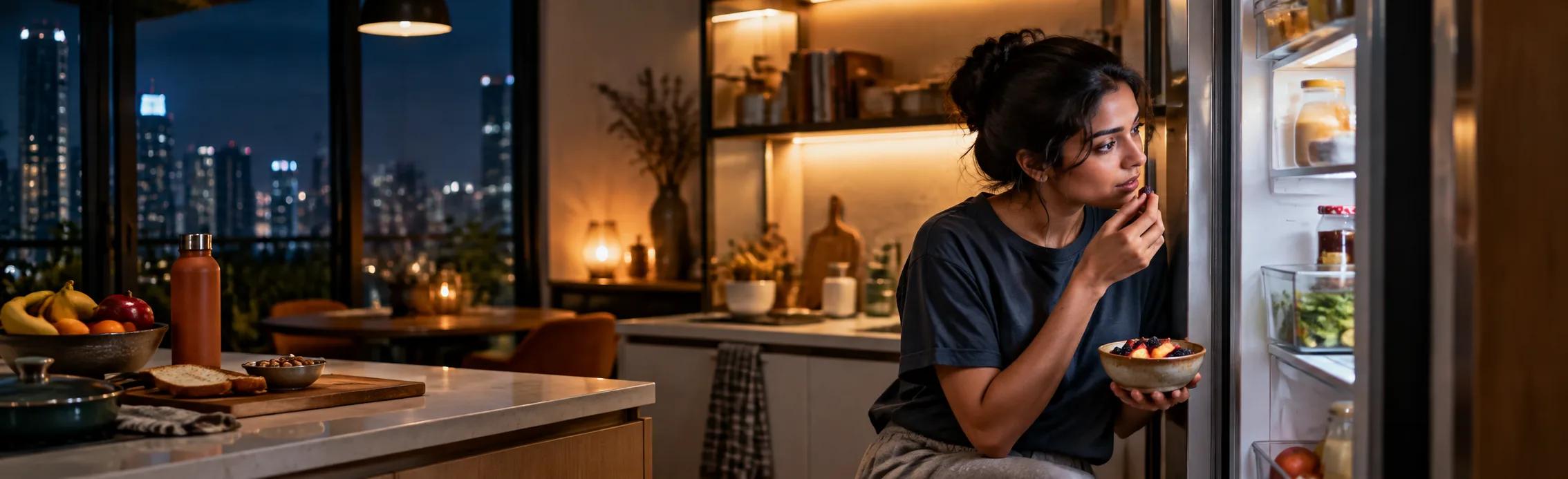
Stress Eating: Why Deadlines Send You to the Snack Drawer
A production bug at 6 pm and your hand is already in the namkeen drawer. Follow the chain from cortisol to the reward system, short sleep and a desk full of snacks, then break it.

In this article(9 sections)
- Link one: The bug lands and your stress system switches on
- Why do some people snack under stress while others skip dinner?
- Link two: The reward system offers a quick fix
- Is the craving for salty namkeen real too?
- Link three: Late nights pour fuel on it
- Link four: The desk makes it easy
- How do you break the chain at your desk?
- When is stress eating something more?
- Sources
It is 6 pm. Work is piling up, your manager needs an update, and you still have a few things to finish before calling it a day. You reach for the namkeen in your drawer, then a piece of chocolate. You had a proper lunch, and you are not particularly hungry. But somehow, snacking makes the pressure feel a little easier to handle. That is stress eating. It happens when you reach for food because you feel tense, overwhelmed or tired, rather than physically hungry. And there is more behind it than a lack of self-control. Stress hormones, the brain's reward system, poor sleep and even having snacks within arm's reach can all play a part. Understanding what triggers that urge can help you find small, practical ways to manage it without giving up the foods you enjoy.
Link one: The bug lands and your stress system switches on

The moment something goes wrong, your brain reads it as a threat. A signal travels from the brain to the adrenal glands, two small glands that sit on top of the kidneys. They release adrenaline for the quick jolt (the racing heart, the tight shoulders) and cortisol for the longer haul. Cortisol makes fuel available in the blood so you can deal with the problem in front of you. The stress system, called the HPA axis, does not work alone. A review in Physiology and Behavior describes it as tightly intertwined with the hormones that regulate appetite. The same wiring that gets you ready to fix the bug also speaks to your hunger.
Why do some people snack under stress while others skip dinner?
Not everyone responds to stress in the same way. In a small laboratory study, 59 healthy women took part in a stressful session on one day and a relaxed session on another. Those whose cortisol levels rose more sharply during stress ate more calories on the stressful day than women whose cortisol rose less. On the relaxed day, both groups ate roughly the same amount. The women with stronger cortisol responses also tended to eat more sweet foods on both days, while bigger drops in mood were linked to eating more. The study was small and included only women, so we cannot assume everyone responds this way. But it helps explain why two people can have completely different reactions to the same stressful day at work. One might lose their appetite altogether, while another keeps reaching for biscuits without even realising how many they have eaten.
Link two: The reward system offers a quick fix
Food that is sweet, fatty or crunchy does more than make you feel full. A review published in Physiology & Behavior suggests another reason we turn to food when stressed. Both stress and enjoyable foods can activate the brain's natural opioid system, which may help calm the stress response. That could explain why a piece of chocolate after a difficult day feels comforting, even if the relief doesn't last long. Over time, your brain may start connecting that feeling of relief with eating. The next time work gets stressful, reaching for a snack can become an almost automatic response. Researchers call this reward-based stress eating. It is a proposed explanation based on animal and human studies, rather than something conclusively proven. But it offers a useful way to understand why the snack drawer becomes so tempting whenever work gets overwhelming.
Is the craving for salty namkeen real too?
The evidence is much stronger for sweet food than for salt. A review in the British Journal of Nutrition found that animal studies suggest stress may drive salt intake. In the few laboratory studies in people, none found that short bursts of stress changed salt intake. One study did link ongoing life stress with eating more snack foods, which included salty snacks among others. The reviewers concluded that for people who already eat more salt than they need, stress is unlikely to be a major driver of salt intake. That points away from a salt signal and towards something simpler: the crunchy packet that happens to be closest to your keyboard.
Link three: Late nights pour fuel on it

During a busy work week, sleep is often the first thing to suffer. A late call with the US team, a last-minute fix or an early meeting can easily cut into your rest. And the next day, you may find yourself reaching for snacks more often than usual. A small randomised crossover study looked at how sleep affects hunger. Twelve healthy young men spent two nights sleeping for shorter periods and two nights getting more sleep, with their food intake and physical activity controlled. After the shorter nights, leptin, a hormone involved in signalling fullness, dropped by an average of 18%, while ghrelin, which stimulates hunger, rose by 28%. The men also reported 24% more hunger and a 33% to 45% increase in appetite for calorie-dense, carbohydrate-rich foods. The study involved only 12 young men, so these numbers may not apply to everyone. Still, the findings offer one possible explanation for why chips or something sweet can seem especially appealing after a poor night's sleep.
If late nights are becoming a regular part of your work routine, our guide on how much deep sleep adults need is a useful place to start.
Link four: The desk makes it easy
The last link is the simplest one. We tend to eat whatever is near us. A Cochrane review pooled 12 studies with 1,098 people that moved a snack or drink nearer or farther away. Placing food farther away led to a moderate drop in how much people ate. The effect grew the farther away the food was. The reviewers rated the certainty of the evidence as low. Most of the studies in the review ran in laboratory settings. Still, moving a packet costs you nothing to test. All of this can come together during a stressful day at work. You're tired, stress is building, and your brain is looking for something comforting. With a packet of namkeen sitting right beside you, reaching for it almost becomes automatic. Before you know it, the packet is empty, and you are still working on the same problem.
How do you break the chain at your desk?
You do not have to fix every link. Pick the one or two that suit your day.
Pause and name it. Before you open the drawer, ask yourself one honest question: am I hungry or am I stressed? If a plate of dal rice would satisfy you, you are probably hungry, so eat something proper. If only the chocolate will do, the deadline may be doing the asking. Naming it does not mean you cannot eat. It means you choose.
Plan the evening snack in the morning. Decide what you will eat around the slump before the slump arrives. Roasted chana, a fruit, a small bowl of curd or a handful of peanuts are easy options. A planned snack is a meal. An unplanned one is a reflex.
Move trigger snacks out of reach. Keep the namkeen in the pantry on another floor, not in your drawer. Leave a fruit on the desk instead. The Cochrane finding above suggests distance alone may reduce how much you eat, though the certainty of that evidence is low.
Walk before you eat. In a workplace simulation study, 78 regular chocolate eaters did computer tasks with a bowl of chocolates within reach. Those who took a 15 minute brisk walk first ate 15.6 grams of chocolate on average, against 28.8 grams for those who rested. Take the stairs or a lap of the campus while your build runs.
Put protein on your lunch plate. A cafeteria lunch of mostly rice or a white bread sandwich gives you little to carry into the evening. Add a bowl of dal, paneer, eggs, curd, rajma or sprouts. Our guide to macronutrients explains how protein, carbohydrate and fat each play their part.
Make sleep a priority during busy work weeks. As the study above suggests, getting too little sleep can leave you feeling hungrier the next day. Late nights may not always be avoidable, but try to protect the sleep you can get. If you have already worked past midnight, spending another half-hour scrolling on your phone will only cut into your rest.
If the pull towards sweets shows up every day, deadline or not, stress may not be the whole story. Our article on why you crave sugar covers the other common reasons.
When is stress eating something more?

Eating more on a hard day is not the same as an eating disorder. Binge eating disorder is different. The NHS describes it as regularly eating a lot of food over a short time until you feel uncomfortably full. It is a serious mental health condition in which people feel they are not in control of their eating. It often starts when people are in their 20s or older. Men and women of any age can have it. Signs listed by the NHS include:
Eating a lot of food in a short time and not being able to stop when full
Eating when you are not hungry
Eating very fast during a binge
Eating alone or in secret
Feeling depressed, guilty, ashamed or disgusted afterwards
If this sounds like you, the NHS advises seeing a doctor as soon as you can. The doctor can refer you to an eating disorder specialist or a team of specialists. The NHS notes that most people recover with the right support and treatment, though it may take time. The main treatments are guided self-help programmes and a talking therapy called cognitive behavioural therapy. You do not need to wait until it feels severe. Speak to a doctor or counsellor too if stress is affecting your mood, sleep or appetite and you are worried or it is not getting better. Check whether your company offers a confidential counselling service.
If you have thoughts of harming yourself or ending your life, get help straight away. If your life is in danger, call 112. If you or someone you know is struggling, call Tele-MANAS on 14416 (free, 24 hours). You can also go to the nearest hospital emergency department.
The bug will get fixed tonight or tomorrow. The habit you build around it lasts much longer, so let the next deadline find you halfway up the stairs, not at the bottom of a namkeen packet.
Sources
Stress, eating and the reward system (Physiology and Behavior, 2007)
Does stress induce salt intake? (British Journal of Nutrition, 2010)
Medical Disclaimer: This article is for general information and is not a substitute for advice from your doctor. Speak to a qualified healthcare professional before starting any supplement, especially if you are pregnant, breastfeeding or taking medication.
Continue this topic
Connected guides, ingredient explainers, product context, and tools chosen from this article's topic cluster.
Cravings, protein, insulin sensitivity, fibre, metabolism basics
Relevant for daily micronutrient coverage during a weight or metabolism plan.
Most Indian breakfasts are mostly cereal. Learn what morning protein really does for fullness, cravings and muscle, plus easy swaps from home food.
Nighttime hunger often has more to do with what happened earlier in the day than the clock. Here is what may be driving late-night cravings and when they deserve a closer look.
walking after meals blood sugar: a practical Aora guide to evidence, label checks, safety cautions, and when supplements make sense.
Quick questions
What is stress eating?
Stress eating is eating because you feel tense or under pressure rather than because you are hungry. Stress hormones such as cortisol interact with the hormones that control appetite. Comfort food may also dampen the stress response for a short while. One review proposes that this helps the habit repeat.
Why do I crave sweets when I am stressed?
In one laboratory study, women whose cortisol rose sharply under stress ate more sweet food than women with a smaller rise. Sweet, tasty food can release the brain's own calming chemicals. A proposed model suggests that brief relief may teach the brain to reach for the same snack next time.
Does lack of sleep make stress eating worse?
It can. In a small study of 12 young men, two short nights lowered the fullness hormone leptin and raised the hunger hormone ghrelin. Hunger and appetite for calorie-dense foods went up. Protecting sleep during a busy week may help keep cravings quieter.
How can I stop stress eating at work?
Pause and ask whether you are hungry or stressed. Plan an evening snack in the morning. Keep trigger snacks away from your desk. Take a brisk walk before you eat. Add dal, paneer, eggs, curd or sprouts to your lunch so you reach the evening less hungry.
When should I see a doctor about stress eating?
See a doctor as soon as you can if you often eat a lot of food in a short time, cannot stop when full, eat in secret or feel ashamed afterwards. These can be signs of binge eating disorder. The NHS says most people recover with the right support and treatment, though it may take time. Also speak to a doctor or counsellor if stress is affecting your mood, sleep or appetite and you are worried or it is not getting better.
7 linked sources checked against our citation and claim-safety process.
Reviewed 14 Oct 2026 for supplement-claim and medical-disclaimer boundaries.
Recommended from the Aora range
Aora Nutrivit Plus
19 Essential Nutrients with Zinc, Magnesium and Vitamins B Complex, C and D3
- Multivitamin
- Daily Foundation
- Made in India
From₹690.00
Try Aora - free
Put this article to work on you.
Health and safety notice
- This article is educational. It is not medical advice and is not a substitute for guidance from a qualified healthcare provider. Consult a physician before starting any supplement, especially during pregnancy or breastfeeding, with a medical condition, or while on medication.
- FSSAI compliance: Health supplements and nutraceuticals are not intended for medicinal use. Any supplement-related information is provided to describe nutritional or physiological support and should not be interpreted as a claim to diagnose, treat, cure, or prevent any disease. FSSAI regulates health supplements and nutraceuticals separately from medicinal products.
Read our full medical disclaimer and editorial policy.
Sources and editorial standards
- 1review in Physiology and Behavior
- 2small laboratory study
- 3review in the British Journal of Nutrition
- 4small randomised crossover study
- 5Cochrane review
- 6workplace simulation study
- 7NHS describes it
Supplement content is educational only and should not replace medical advice from a qualified clinician. Product mentions are reviewed for claim safety before publication.