5 Bone Density Exercises at Home for Adults Over 50
Five practical bone density exercises for adults over 50, with safe ways to progress, improve balance and support stronger bones at home.
In this article(14 sections)
- Why bone density exercises matter after 50
- Before you start bone density exercises at home
- 5 bone density exercises you can do at home
- 1. Sit-to-stand squat
- 2. Step-ups
- 3. Resistance-band row
- 4. Heel-to-toe walking
- 5. Supported small hops, only when appropriate
- A simple weekly routine
- Is walking enough for bone density?
- How do you know whether the exercises are working?
- Nutrition supports your exercise routine
- Also read
- Medical Disclaimer
Why bone density exercises matter after 50
Bone is living tissue that responds to the loads placed on it. As we age, bone continues to be broken down and rebuilt, but the balance gradually shifts towards greater bone loss. After menopause, this can speed up because oestrogen levels fall. Men also lose bone with age, although the pattern is usually more gradual. Bone density exercises give bones a reason to adapt. The National Institute of Arthritis and Musculoskeletal and Skin Diseases recommends weight-bearing, muscle-strengthening and balance exercise as part of bone care. The goal is not simply to move more. Bone density exercises need enough load to challenge muscles and bones safely, while balance work reduces fracture risk by helping prevent falls. You do not need a gym to start. Bone density exercises at home can be effective when they provide enough resistance and are progressed over time. The best bone density exercises are the ones you can perform with good technique, repeat consistently and progress as you become stronger. If an exercise that once felt challenging becomes very easy, that is usually a sign to increase the resistance, repetitions or difficulty rather than doing the same easy version forever.
Before you start bone density exercises at home
Take five to ten minutes to warm up with easy walking and gentle shoulder, ankle and hip movement. Keep a stable chair, wall or countertop nearby if your balance is uncertain. Bone density exercises should feel like effort, but they should not cause sharp pain, chest pain, dizziness or unusual shortness of breath. If you have osteoporosis, osteopenia with a high fracture risk, a previous fragility fracture or a spinal fracture, get individual advice before trying impact exercise or movements that involve repeated deep spinal bending or twisting. The Royal Osteoporosis Society explains how exercise can be adapted according to fracture history and physical ability.
5 bone density exercises you can do at home
1. Sit-to-stand squat
Sit-to-stand squats strengthen the thighs, hips and buttocks. These muscles help you get out of a chair, climb stairs and control your body as you lower yourself into a seat. Because the hips and legs work against your body weight, sit-to-stands are useful bone density exercises for adults who are new to strength training.
Sit near the front of a sturdy chair with your feet about hip-width apart. Keep your chest lifted, lean forward slightly and stand without using your hands if you can do so safely. Lower yourself back to the chair slowly rather than dropping into the seat. Start with 8 to 12 repetitions and repeat for one or two sets.
When 12 controlled repetitions become comfortable, hold a light weight, water bottle or book close to your chest. The Royal Osteoporosis Society recommends gradually increasing resistance as strength improves. Bone density exercises work better when the challenge progresses instead of staying permanently easy.
2. Step-ups
Step-ups strengthen the thighs, hips and buttocks while practising a movement used in everyday life. They also provide weight-bearing load because your skeleton supports your body against gravity. This combination makes step-ups practical bone density exercises for the lower body.
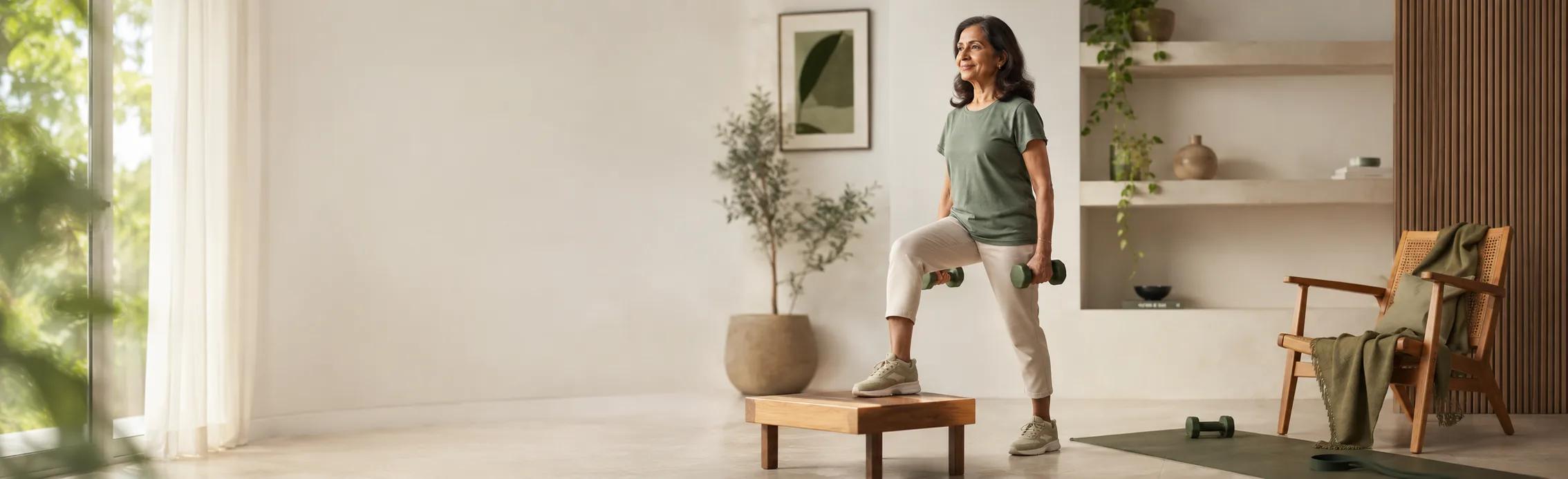
Use the bottom step of a staircase and stay close to a banister or wall. Step up with one foot, bring the other foot onto the step, then step down with control. Repeat with the other leg leading. Begin with about 8 repetitions on each side and avoid swinging your body or leaning heavily forward to create momentum.
Once the movement feels steady, you can add repetitions, use a slightly higher step or hold a light weight. Progress one variable at a time. Bone density exercises should become harder because you are stronger, not because you are losing control of the movement.
3. Resistance-band row
A good routine should not focus only on the hips and legs. Resistance-band rows strengthen the upper back, shoulders and arms and provide resistance through the upper body. Upper-body bone density exercises matter because bone adapts most strongly at the sites being loaded.
Attach a resistance band to a secure exercise anchor at about chest height. Hold one end in each hand, step back until there is light tension, then draw your hands towards your ribs while gently bringing your shoulder blades together. Return slowly. Do not attach the band to a loose door handle or unstable piece of furniture.
Start with 8 to 12 repetitions for one or two sets. When 12 controlled repetitions feel easy, use a slightly stronger band. As with other bone density exercises, resistance should increase gradually while technique stays controlled.
4. Heel-to-toe walking
Heel-to-toe walking is mainly a balance drill rather than a direct bone-building movement. It still belongs beside bone density exercises because preventing falls is a major part of preventing fractures, especially later in life.
Stand beside a wall or kitchen counter. Place the heel of one foot directly in front of the toes of the other, then continue slowly in a straight line while looking ahead. Use the wall for support whenever you need it. Practise for about 30 seconds and repeat two or three times.
The Royal Osteoporosis Society recommends balance work as part of a wider programme to reduce falls and broken bones. Balance training does not replace bone density exercises, but it makes a bone-health routine safer and more complete.
5. Supported small hops, only when appropriate
Small hops create more impact than walking, which can provide a stronger loading stimulus to bone. The Royal Osteoporosis Society describes different levels of impact and explains that the right level depends on bone health and fracture risk.
Do not add hopping without professional advice if you have osteoporosis with high fracture risk, a previous spinal or fragility fracture, poor balance, severe knee, hip or back pain, a recent operation or difficulty landing safely. Impact-based bone density exercises are useful only when they match your ability and risk profile.
If impact exercise is appropriate for you, hold a fixed countertop, keep your knees softly bent, make a very small hop and land quietly on both feet. Start with only a few repetitions and stop if you feel pain or unsteady. If hopping is not appropriate, brisk walking, stair climbing and low-impact dancing are useful weight-bearing alternatives.
A simple weekly routine
For a generally healthy adult, a home plan can include the three strength-based bone density exercises on two non-consecutive days each week, with walking and balance practice on other days. Recovery matters because muscles need time to adapt to resistance work.
A simple week might look like this:
Monday: sit-to-stand squats, step-ups and resistance-band rows
Tuesday: brisk walking and heel-to-toe walking
Wednesday: easy walking, normal daily activity or rest
Thursday: repeat the three strength exercises
Friday or Saturday: brisk walking and balance work
Optional impact: add a few supported hops only if they are safe for you
The exact schedule matters less than consistency and progression. Bone density exercises are more useful when you can repeat them for months and gradually increase the challenge rather than completing an intense routine for a few days and stopping. Keeping a simple record of your bone density exercises can make that progression easier to see.
Is walking enough for bone density?
Walking is a valuable weight-bearing activity and a good starting point for someone who has been inactive. It also supports cardiovascular fitness, mobility and confidence. However, walking alone does not load every part of the skeleton strongly enough to replace resistance training.
For most adults, combine walking with bone density exercises that add resistance and with balance work. The NIAMS exercise guidance includes walking among weight-bearing activities but also recommends strengthening exercise as part of bone care.
How do you know whether the exercises are working?
You cannot feel a change in bone mineral density directly. What you may notice first is better function: standing from a chair more easily, climbing stairs with less effort, completing more repetitions or feeling steadier when you walk. These improvements show that the bone density exercises are strengthening the muscles and movement skills that protect your skeleton even before a scan changes.
A DXA or DEXA scan is the standard test used to measure bone mineral density, usually at the hip and spine. NIAMS explains that for postmenopausal women and men aged 50 or older, a T-score of -1 or higher is considered within the healthy range, between -1 and -2.5 indicates low bone density or osteopenia, and -2.5 or lower is in the osteoporosis range.
Not everyone over 50 needs routine screening. The U.S. Preventive Services Task Force recommends screening women aged 65 and older and younger postmenopausal women at increased fracture risk. Evidence is currently insufficient to recommend routine screening for all men, so individual risk should guide the decision.
Nutrition supports your exercise routine
Bone density exercises provide the loading signal, but nutrition supplies the materials your body needs. Calcium contributes to bone structure, vitamin D helps the body absorb calcium, and protein supports the muscle that creates mechanical load and helps you stay steady.
NIAMS guidance on calcium and vitamin D recommends meeting calcium and vitamin D needs through food and supplements when needed. Useful foods include dairy or calcium-fortified alternatives, calcium-set tofu, leafy vegetables, small fish with edible bones, eggs, pulses, fish and lean meat.
If a supplement is appropriate for your routine, Aora Collacose contains glucosamine, MSM, type II collagen, vitamin D3 and K2-7 and is positioned for bone and joint support. It is not a treatment for osteoporosis and should not replace prescribed medicine, fracture assessment or bone density exercises.
Also read
Strong Bones After 50: Habits, Nutrition and Exercise Tips
7 Best Foods to Eat After 50 for Strength and Healthy Ageing
Medical Disclaimer
This article is for general educational purposes only and should not replace professional medical advice, diagnosis or treatment. Speak to a qualified healthcare professional before starting new bone density exercises if you have osteoporosis, previous fractures, severe joint or back pain, significant balance problems or another medical condition. Seek medical care for chest pain, fainting, severe breathlessness or sudden severe pain during exercise.
Continue this topic
Connected guides, ingredient explainers, product context, and tools chosen from this article's topic cluster.
Creatine is everywhere now. Learn what research shows on safety, kidneys, hair, women, older adults and the brain. Plus how much to take.
Vitamin D3 helps your gut absorb calcium and many Indians run low. Why a blood test comes first and how to use D3 safely for your bones.
Vitamin D deficiency can affect bones and muscles. Learn symptoms, risk factors, blood testing, treatment and why high doses need medical guidance.
Quick questions
Quick answer Bone density exercises after 50 should combine resistance, weight-bearing movement and balance work. Sit-to-stand squats, step-ups, resistance-band rows and balance drills are practical options at home. Small hops can add impact for some adults, but they are not suitable for everyone,
Walking is a valuable weight-bearing activity and a good starting point for someone who has been inactive. It also supports cardiovascular fitness, mobility and confidence. However, walking alone does not load every part of the skeleton strongly enough to replace resistance training.
How do you know whether the exercises are working?
You cannot feel a change in bone mineral density directly. What you may notice first is better function: standing from a chair more easily, climbing stairs with less effort, completing more repetitions or feeling steadier when you walk. These improvements show that the bone density exercises are strengthening the muscles and movement skills that protect your skeleton even before a scan changes.
What is the practical takeaway from bone density exercises?
Five practical bone density exercises for adults over 50, with safe ways to progress, improve balance and support stronger bones at home.
Should I use a supplement for bone density exercises?
A supplement can be considered when there is a clear gap, goal, or label-backed reason. It should not replace medical care, diagnosis, or treatment.
8 linked sources checked against our citation and claim-safety process.
Reviewed 2 Sept 2026 for supplement-claim and medical-disclaimer boundaries.
Recommended from the Aora range
Aora Nutrivit Plus
19 Essential Nutrients with Zinc, Magnesium and Vitamins B Complex, C and D3
- Multivitamin
- Daily Foundation
- Made in India
From₹690.00
Try Aora - free
Put this article to work on you.
Health and safety notice
- This article is educational. It is not medical advice and is not a substitute for guidance from a qualified healthcare provider. Consult a physician before starting any supplement, especially during pregnancy or breastfeeding, with a medical condition, or while on medication.
- FSSAI compliance: Health supplements and nutraceuticals are not intended for medicinal use. Any supplement-related information is provided to describe nutritional or physiological support and should not be interpreted as a claim to diagnose, treat, cure, or prevent any disease. FSSAI regulates health supplements and nutraceuticals separately from medicinal products.
Read our full medical disclaimer and editorial policy.
Sources and editorial standards
- 1The National Institute of Arthritis and Musculoskeletal and Skin Diseases
- 2The Royal Osteoporosis Society
- 3The Royal Osteoporosis Society
- 4The Royal Osteoporosis Society
- 5The Royal Osteoporosis Society
- 6NIAMS
- 7U.S. Preventive Services Task Force
- 8NIAMS guidance on calcium and vitamin D
Supplement content is educational only and should not replace medical advice from a qualified clinician. Product mentions are reviewed for claim safety before publication.