How to Measure Blood Pressure at Home Correctly: A Step-by-Step Guide
Small details such as your sitting position, cuff size or a cup of coffee before measuring can affect a home blood pressure reading. Here is how to check it properly and get more useful results.
In this article(17 sections)
- Why the way you measure blood pressure matters
- Before You Measure: Get These Basics Right
- How to Measure Your Blood Pressure at Home
- 1. Sit in a Supportive Chair
- 2. Put the Cuff on Your Upper Arm
- 3. Rest Your Arm on a Table
- 4. Stay Still While It Measures
- 5. Take a Second Reading
- Common Mistakes that Can Affect a Home Blood Pressure Reading
- What to Do If Your Blood Pressure Readings Are Different
- How Often Should You Check Your Blood Pressure at Home?
- Should You Check Your Blood Pressure at the Same Time Every Day?
- What Should You Write Down?
- What If You Get One High Reading?
- When Does a Very High Reading Need Attention?
- Consistency Matters More Than a Single Reading
- Sources
Measuring your blood pressure at home takes just a few minutes, but in reality, it is not that simple. If you have tried doing it, you might agree that the tricky part is making sure the number you get is one you can actually trust. Sometimes, small things that you don't often think about can change the reading. Things like drinking coffee, talking during the reading, crossing your legs or resting your arm in the wrong position can all make a difference. Even the size of the cuff matters. That becomes important when you are checking your blood pressure over days or weeks. A single reading can be useful, but a series of readings taken under similar conditions gives you a much better idea of your usual numbers. If you are wondering how to measure blood pressure at home correctly, we take you through the process step by step, from preparing for the reading and positioning the cuff to getting a reading you can actually use.
Why the way you measure blood pressure matters
Blood pressure changes naturally throughout the day, so one reading does not always tell the whole story. Your activity, stress levels, caffeine and even how recently you have been moving around can change the number. That is why the conditions around each measurement matter when you are tracking your blood pressure at home. The Centers for Disease Control and Prevention (CDC) recommends taking your blood pressure while seated, with your back supported, feet flat on the floor and your arm supported at about chest height. Taking readings in a similar way each time makes them easier to compare and helps you and your healthcare professional see your usual pattern over time.
Before You Measure: Get These Basics Right

Sit quietly for five minutes: Find a chair with back support and sit with your feet flat on the floor. Use these few minutes to settle down before you start. Try not to talk, scroll through stressful messages or move around unnecessarily.
Give yourself some time after activity: Don’t check your blood pressure immediately after exercise, walking up the stairs or any other activity that leaves you short of breath. The American Heart Association recommends avoiding exercise, smoking and caffeinated drinks for at least 30 minutes before measuring. It also recommends emptying your bladder beforehand.
Check the cuff size: The cuff needs to fit your upper arm properly. A cuff that is too large or too small can affect the accuracy of the reading. Check the arm-size range printed on the cuff or in the manufacturer’s instructions and make sure it matches your upper-arm circumference. This is particularly important if you have very small or large upper arms.
How to Measure Your Blood Pressure at Home
Once you are rested and ready, the actual measurement is quite straightforward. Follow these steps each time so you know you're using the monitor correctly.
1. Sit in a Supportive Chair
Sit upright in a chair rather than lying down or sitting on the edge of a bed. Keep your:
Back supported
Feet flat on the floor
Legs uncrossed
Body relaxed
2. Put the Cuff on Your Upper Arm
Place the cuff directly against your skin rather than over your clothes. Follow the placement instructions that came with your monitor. With most upper-arm cuffs, the lower edge sits just above the bend of the elbow. Don’t roll up your sleeve too tightly. If it feels tight around your upper arm, take your arm out of the sleeve instead.
3. Rest Your Arm on a Table
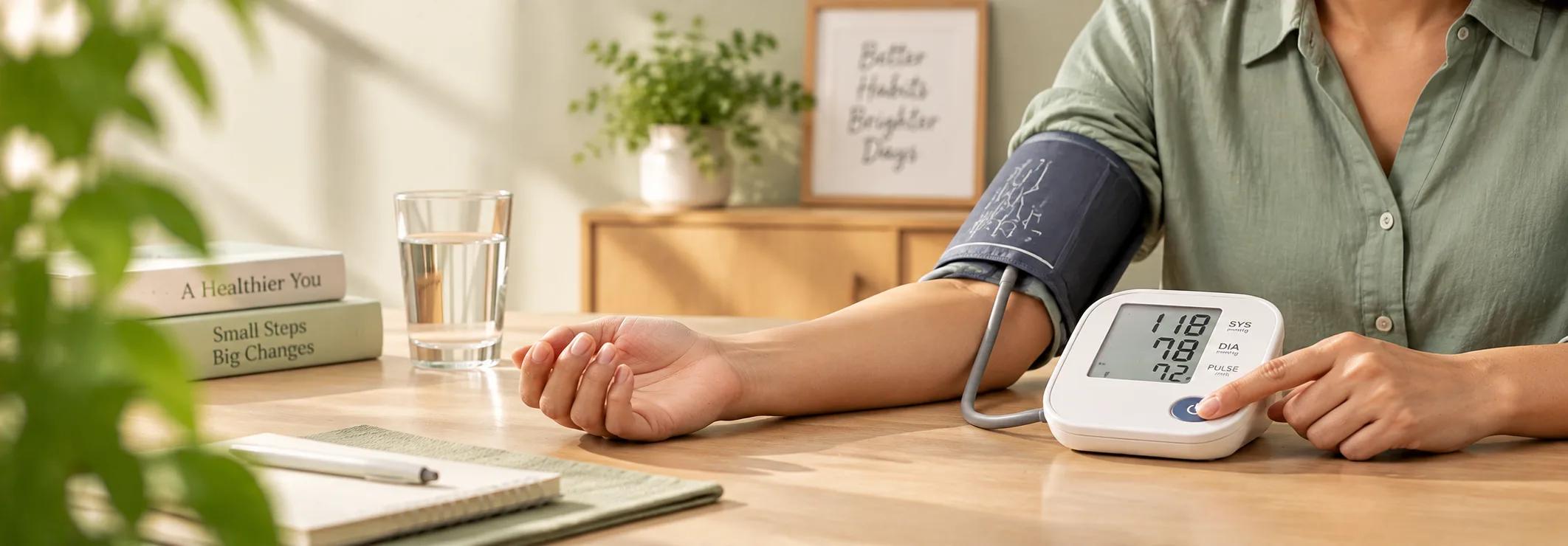
Rest your arm on a table or desk so your upper arm is roughly level with your heart. Don’t hold your arm up yourself or let it hang by your side. If the table is too low, place a folded towel or cushion under your arm to bring it up to a comfortable height.
4. Stay Still While It Measures
Once you press the start button, let the monitor take the reading without doing anything else. Keep your arm still and stay quiet while the cuff inflates and then slowly releases. Try not to talk, laugh, move your arm or reach for your phone, as even small movements can affect the reading. You don’t need to hold your breath or change the way you breathe either. Just sit comfortably and breathe normally until the process is complete.
5. Take a Second Reading
Don’t worry if the first number is not quite what you expected. Wait at least one minute and take another reading. The American Heart Association recommends taking two readings one minute apart when checking your blood pressure at home. Write down both readings. It is completely normal for the two numbers to be slightly different. If your healthcare professional has asked you to calculate or report an average, follow the method they recommend.. It is completely normal for the two numbers to be slightly different.
Common Mistakes that Can Affect a Home Blood Pressure Reading
Once you know the basic steps, it is also worth knowing what can throw a reading off. Most of these mistakes are easy to make because they are part of your normal routine. You may not even realise they can make a difference.
Measuring right after exercise: Wait at least 30 minutes.
Having coffee just before: Wait about 30 minutes after caffeine.
Measuring with a full bladder: Use the toilet first.
Sitting without back support: Sit in a chair that supports your back.
Crossing your legs: Keep both feet flat on the floor.
Letting your arm hang down: Rest your arm on a surface at heart level.
Putting the cuff over clothes: Place it directly on bare skin.
Using the wrong cuff size: Check that the cuff fits your arm.
Talking during the reading: Stay quiet until the reading is finished.
Relying on one reading: Take two readings at least one minute apart.
These may seem like small details, but avoiding them can make your home readings more consistent and easier to understand over time.
What to Do If Your Blood Pressure Readings Are Different
They probably will be, at least occasionally. Blood pressure can change from one moment to the next, so a small difference between two readings does not necessarily mean you did something wrong. Don’t keep measuring until you get a number you like. Instead, record both readings and look at them together. If one reading is much higher or lower than what you normally see, first think about what happened just before you measured. Was the cuff in the right position? Was your arm supported? Did you move or talk during the reading? Were your legs crossed? Had you just exercised or had caffeine? Did you sit quietly before measuring?
If you notice that something was wrong with the way you measured, fix it, sit quietly for a few minutes and repeat the reading. If your readings continue to look unusual, it is better to discuss them with a healthcare professional than to keep checking every few minutes.
How Often Should You Check Your Blood Pressure at Home?

It depends on why you are monitoring it. Someone checking their blood pressure occasionally will have a very different routine from someone whose doctor is checking for possible hypertension or adjusting treatment. If home monitoring is being used to help confirm a diagnosis of hypertension, National Institute for Health and Care Excellence (NICE) recommends taking two readings at least one minute apart, twice a day, ideally in the morning and evening, for at least four days and preferably seven. The first day’s readings are left out and the remaining readings are averaged. This is a specific monitoring schedule used for diagnosis. It does not mean everyone with a blood pressure monitor needs to check it four times a day. If your healthcare professional has asked you to monitor your blood pressure at home, follow the schedule they recommend for you.
Should You Check Your Blood Pressure at the Same Time Every Day?
If you are checking your blood pressure regularly, taking it at roughly the same time can make your readings easier to compare. Try to keep the conditions similar too, as this can make changes in your readings easier to understand. Morning and evening readings are commonly used when home monitoring is being done to check for possible hypertension. Your healthcare professional may recommend a different schedule depending on your medicines or other health conditions. Don’t change when or how you take prescribed medicine just to fit your blood pressure routine. Follow the schedule your doctor has given you.
What Should You Write Down?
You don’t need a complicated spreadsheet to keep track of your readings. A simple record with the date, time, first reading and second reading is usually enough. You can also add a quick note if something unusual happened that could have affected the reading, such as exercising beforehand or feeling unwell. Many home monitors save readings automatically. If yours does, take the monitor or its stored readings with you to your appointment. The American Heart Association also recommends taking your home monitor to a medical appointment so your healthcare professional can check the device and your technique.
What If You Get One High Reading?
An unexpectedly high number can be worrying, but one reading by itself does not diagnose hypertension. First, check that you were sitting correctly and that the cuff was positioned properly. Rest quietly and take another reading rather than checking repeatedly every few minutes.
What matters more is the pattern across several properly taken readings, along with your medical history and any measurements reviewed by your healthcare professional. Don’t start, stop or change prescribed blood pressure medicine because of one home reading unless your clinician has already given you specific instructions. If you are also comparing products marketed for cardiovascular or blood pressure support, Aora's Heart Health Supplement Red Flags explains what deserves extra caution.
When Does a Very High Reading Need Attention?
A very high reading should not be ignored. The American Heart Association advises waiting at least one minute and checking again if your reading is higher than 180/120 mmHg. If it is still that high, contact a healthcare professional promptly. If the high reading comes with symptoms such as chest pain, shortness of breath, weakness or numbness, difficulty speaking, vision changes or other severe symptoms, seek emergency medical care. In that situation, don’t keep checking your blood pressure at home and wait for the number to come down.
Consistency Matters More Than a Single Reading
Knowing how to measure blood pressure at home is not just about knowing which button to press. The few minutes before you start, the way the cuff fits and how you sit can all make a difference to the reading you get. The good news is that you don’t need a complicated routine. Use a validated monitor with the right cuff size, sit quietly for five minutes, keep your back supported and your feet flat on the floor, and rest your arm comfortably at heart level. Stay quiet while the monitor is working, then take a second reading after at least one minute and record both. Most importantly, don’t let one number worry you or make you feel that something is wrong. Blood pressure naturally changes throughout the day, so one reading only shows what was happening at that moment. Taking your readings properly and keeping a record over time gives you a much clearer picture and can help your healthcare professional understand what is really going on.
For another cardiovascular measure where the pattern over time matters more than one isolated number, see Resting Heart Rate at Night: What’s Normal and What Can Raise It?.
Sources
Centers for Disease Control and Prevention: Measuring Your Blood Pressure
National Institute for Health and Care Excellence: Hypertension in Adults, Diagnosis and Management
Mayo Clinic: Get the Most Out of Home Blood Pressure Monitoring
Medical Disclaimer: This article is for general educational purposes only and is not a substitute for medical advice, diagnosis or treatment. Blood pressure targets and monitoring schedules can vary depending on your health, medicines and individual circumstances. Do not start, stop or change prescribed medication based on home blood pressure readings without speaking to a qualified healthcare professional. Seek urgent medical care if you have a very high blood pressure reading accompanied by concerning symptoms.
Continue this topic
Connected guides, ingredient explainers, product context, and tools chosen from this article's topic cluster.
Hair on your pillow, brush or bathroom floor does not always mean the same thing. Learn the signs that can help you tell increased shedding from hair breakage.
Milk thistle is the plant, while silymarin is a group of compounds found in its extract. Understanding that difference can make supplement labels much easier to compare.
Learn how sun protection, protein, vitamin C, sleep, diet and collagen supplements may affect skin ageing, and what matters most.
Quick questions
1. Can I Measure My Blood Pressure Immediately After Walking?
It is better to wait a little. Walking and other physical activity can temporarily raise or change your blood pressure, so measuring straight afterwards may not give you a good idea of your usual reading. Give yourself at least 30 minutes after exercise, then sit quietly for about five minutes before checking it.
2. Why Is My Blood Pressure Different Every Time I Check?
Some variation is normal. Your blood pressure can change with activity, stress, caffeine, posture and even the time of day. Your first and second readings may also be slightly different. Instead of worrying about every small change, keep taking your readings in a similar way and look at the pattern over several days.
3. What Type of Blood Pressure Monitor Should I Use?
For most people, an automatic upper-arm monitor is the better choice. Look for a validated device and make sure the cuff fits your arm properly. Wrist and finger monitors are generally less reliable, so an upper-arm monitor is usually the simpler option for regular home checks.
4. Should I Use the Same Arm Every Time?
You can usually measure on either arm. If you are going to track your blood pressure regularly, however, using the same arm can make your readings easier to compare. If your healthcare professional has asked you to use a particular arm, follow their advice.
5. Should I Take Two or Three Blood Pressure Readings?
For a usual home check, take two readings at least one minute apart and write both down. Your healthcare professional may ask you to take more readings or follow a particular schedule if they are checking for hypertension or monitoring your treatment. 6. What If I Get One High Blood Pressure Reading? One high reading does not necessarily mean you have hypertension. Sit quietly and check it again after at least one minute, then record both results. If your reading is above 180/120 mmHg, wait at least a minute and check again. If it remains that high, contact a healthcare professional promptly. If you also have symptoms such as chest pain, shortness of breath, weakness, numbness, vision changes or difficulty speaking, seek emergency medical care.
4 linked sources checked against our citation and claim-safety process.
Updated 15 Sept 2026 with supplement-claim and medical-disclaimer boundaries.
Recommended from the Aora range
Nutrivit Plus | Supports Immune Function & Energy Metabolism
19 Essential Nutrients with Zinc, Magnesium and Vitamins B Complex, C and D3
- Multivitamin
- Daily Foundation
- Made in India
From₹690.00
Try Aora - free
Put this article to work on you.
Health and safety notice
- This article is educational. It is not medical advice and is not a substitute for guidance from a qualified healthcare provider. Consult a physician before starting any supplement, especially during pregnancy or breastfeeding, with a medical condition, or while on medication.
- FSSAI compliance: Health supplements and nutraceuticals are not intended for medicinal use. Any supplement-related information is provided to describe nutritional or physiological support and should not be interpreted as a claim to diagnose, treat, cure, or prevent any disease. FSSAI regulates health supplements and nutraceuticals separately from medicinal products.
Read our full medical disclaimer and editorial policy.
Sources and editorial standards
- 1Centers for Disease Control and Prevention (CDC)
- 2American Heart Association
- 3National Institute for Health and Care Excellence (NICE)
- 4Mayo Clinic: Get the Most Out of Home Blood Pressure Monitoring
Supplement content is educational only and should not replace medical advice from a qualified clinician. Product mentions are reviewed for claim safety before publication.